

For weeks now, the narrative of the Torah has slowed and the text primarily has focused on mitzvahs, duties of the Kohanim and Leviim, and copious census taking. From here until the end of the book of Bamidbar, the Torah will jump back and forth between narrative and mitzvahs. Along with this shift in style, the Torah contains an oddity that many rabbis don’t just consider a note worthy, but may indicate a whole book of the Torah.
Verses 10:35 and 36 read, “So it was, whenever the ark set out, Moses would say, Arise, O Lord, may Your enemies be scattered and may those who hate You flee from You. And when it came to rest he would say, Repose O Lord, among the myriads of thousands of Israel.” The first thing you may notice is that the first of the two verses is recited whenever we take out the Torah from the ark in shul. But the second thing to notice can only been seen in the text. In Hebrew, the section is peculiarly set apart, bordered by two inverted nuns, as if they were parenthesis.
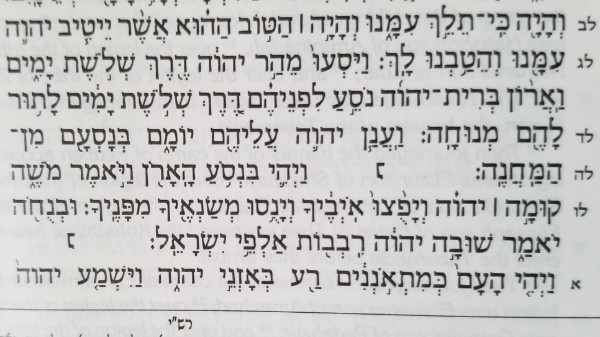
There are many typographical anomalies throughout the Torah. Sometimes a letter is oversized, other places you can find a letter is shrunk, the vav in parshas Pinchas is broken, etc. And though there is always commentary surrounding these oddities, in this case, rabbis in the Gemara go as far as to consider these two lines a whole separate book of the Torah.
From this perspective, Bamidbar is separated into three books, everything before 10:35, these two verses , and everything after until the book of Devarim would each constitute separate books of the Torah, making the total tally not five, but seven! Why do some rabbis regard this insertion with such prominence and what does that mean for us?
Broken Order
Rashi comments that the inverted nuns serve to note that the passage is taken out of context from another place in the Torah. His reason for the diversion being, “To make a break between one punishment and the next…” For a little bit of context, the Jewish people have been camped at Mount Sinai for almost two years. Once they leave, it isn’t long before they start complaining about the pace of the journey, then about their food, and so on. And for each complaint God reprimands their ingratitude. But the additional verses aren’t inserted in the midst of these offenses like Rashi comments, but instead before them. So it doesn’t seem to serve as a break between punishments.
However, the verse before the break referring to the Jews departing from Sinai, according to the Gemara, contains a veiled criticism. The Midrash characterizes the Israelites departure from Mt. Sinai as “They left in a hurry, just as school children dash out of school at the end of the day.” They acted like it was summer vacation. By leaving speedily, it was apparent that they viewed the Torah and mitzvahs as a burden rather than something to cherish. So God inserts the additional verses after their departure to break up their series of transgressions. If we give it to Rashi that this is an interruption to make the Jewish people not look so bad, fine. But why are we calling these two verses a book?
Turning the Page

The school children metaphor is used as a rebuke for a lack of reverence for the Torah, going as far as to imply they were turning away from Torah. From here the Jewish people begin making a series of errors that will lead to some serious troubles. It will start with small complaints but will fester, leading to the sin of the spies which bars this generation from entering the land of Israel. There will be Korach’s rebellion, more complaining, and wanton public disregard for the Torah at the end of parshas Balak. It is very clear that this moment is a turning point for the Jewish people.
But I think this metaphor about school children goes even deeper than rebuke about acting immature. When students leave the classroom, they close the book on their studying.
I’m bad a picking up a book once I’ve put it down for a while. I forget characters, events, I’ll even read a couple of pages before my bookmark and it is as if I haven’t ever read them before. The sad fact is that if I put a book down for more than a couple of weeks, I’m going to need to restart it. Or worse, I may never pick up the book ever again. But if I’m reading a whole book series, do I need to go back to book one? I hope not (it depends how long I’ve put the book down for.)
There’s no question that the “books” we’re studying in our lives end up getting put down before we finish them. Whether that is literally a novel, or a podcast, a skill we’re trying to develop, a personal project we’re working on, or most importantly our growth in Torah. It’s going to get away from us and our lives are going to go off track. How do we get back on track? Do we need to start over from the beginning? Hopefully not. But maybe we need only to restart the most recent book.
The Jewish people clearly went off track just as we do. I think the message of the two verses being a book is to tell us that when we have gone off track, we don’t have to start all over. God interrupts the flow of the book of Bamidbar to give us a jumping on point. Go back to where things started to go wrong and start reviewing and rewriting. And so we say verse 35, whenever we read that Torah publicly to remind us of this fact. Go back to reading the Torah, the wisdom, of where you left off and your enemies (problems) will scatter. You don’t have to start all over from the beginning. And I’ll just point out the coincidence that we’re reading this parsha as many school children are about to begin their summer vacation. How interesting.
 Six Degrees Of Kosher Bacon