

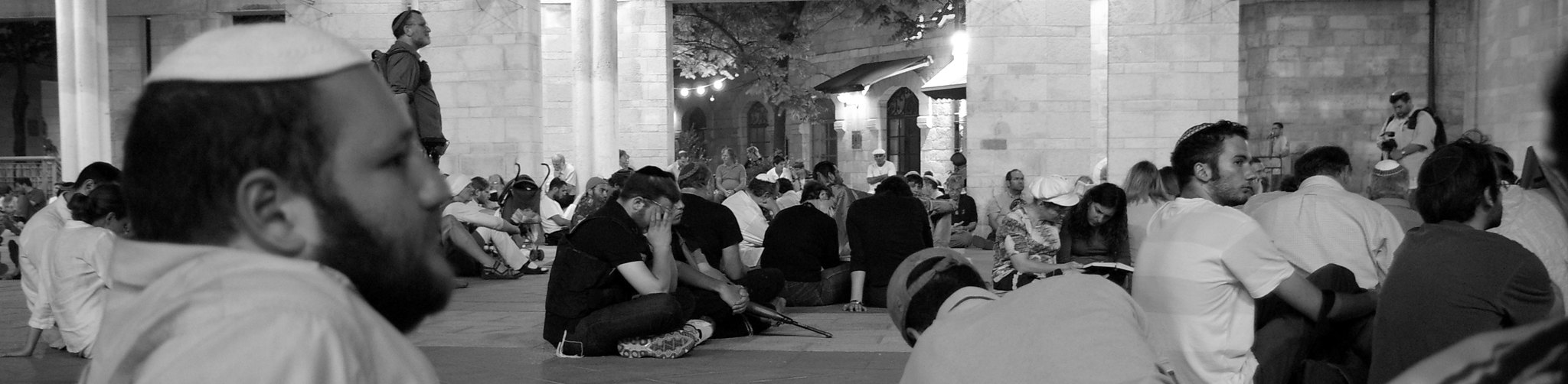
As we observe yet another Tisha b’Av, many of us will mutter, hopefully next year we won’t be fasting, but feasting. The essential date that codifies the worst atrocities the Jewish people have had to suffer is prophesied to one day, flip and be a day of rejoicing. As soon as the moshiach comes. But as we begin our 1,956th year of our exile, it’s clear that we’ve not figured out the lesson we were meant to learn.
The primary reason given is sinas chinam – “baseless hatred.” Yet, no matter how many times we hear that phrase, it doesn’t seem to inspire any change. What are we misunderstanding? Or perhaps, more appropriately, why don’t we care? (Note that virtually everything in this blog post is taken from Rabbi Eliyahu Dessler’s Strive for Truth. Look there for more details.)
Exile of the Shechinah
First and foremost, we all understand we are living in exile. The destruction of the Temple(s) was followed by the Jewish people being sent from the land of Israel and sent to live among the nations. Though today we are back in the modern State of Israel, redemption still eludes us as we don’t have the Third Temple. Why should the lack of a Temple define our exile?
The true essence of our exile has less to do with borders and far more to do with our spiritual estrangement. Most essentially, our connection to Hashem. Hashem’s presence in the physical world is referred to as the Shechinah. (Interesting to note that Shechinah literally means “to dwell” and is also a feminine conjugation. So according to Judaism, God’s presence on Earth is a woman. So to speak.) Because of our exile, the Shechinah is hidden and our ability to feel Godliness is heavily hindered.
However, the Temple is not the only place the Shechinah dwells. Exodus/Shemot 25:8 says, “They shall make Me a Sanctuary (i.e. Temple) and I will dwell in their midst.” Note: it doesn’t say it its midst, but their midst. The true dwelling place of the Shechinah is within the hearts and minds of the Jewish people. We should have been able to return from exile all along. So why can’t we click our heels together three times and say “There’s no place like home”?
Changing Influences
The inner spark of spirituality found in every Jew can never be extinguished completely. But to rekindle that connection is no easy task. Which brings us to the spirit of Tisha B’Av, mourning and lamentation. We get no points for fasting for the sake of fasting. We are not meant to afflict ourselves for the sake of punishment. It is meant to inspire us to abandon meaningless pursuits and return to holiness and Torah. But if that’s the case, why would God send the Jews out from the holy Land of Israel and scatter us among the nations? It would seem that over the last 2,000 years, this exile has sent most Jews farther away from Torah and observance! Hasn’t the enlightenment, scientific revolution, and assimilation all but extinguished our connection to the Shechinah?
To answer that we need to consider two aspects. 1) The nations we have been exiled to. 2) The “sins” that impede our connection to the Shechinah. Jewish tradition views the concept of a “nation” not as a country with borders or a genealogical race. Instead it considers a “nation” to be an outlook that is a part of the human experience. In ancient times, that outlook was relegated to a distinct group of people. But today that’s sort of all mixed up. So the way we’d refer to “western civilization” would be a better approximation of how Judaism uses the term “nation.”
Rabbi Dessler makes a distinction between two types of sins. Those caused by desire (ta’avah or craving) and those caused by a lust for power and domination (ga’avah or pride). Ta’avah’s are rooted in the body. Because of that, it is possible to overdo a bodily craving and feel the pains of remorse and regret. Ga’avah on the other hand, knows no satisfaction and is much more difficult to turn from. The loss of the First Temple was attributed to the sins of murder, idol worship, and sexual immorality. These are all ta’avahs, the cravings of the body. So the nations we were exiled by (Egypt, Babylonia, and Persia) were all characterized by those ta’avahs. And like those ta’avahs there was a limit of indulgence the Jewish people could take before we finally did teshuvah (repentance).
Why our Current Exile is Different
Unfortunately, the “sin” of sinas chinam – baseless hatred – falls into the second category, ga’avah. It is an insatiable desire for pride and power. What’s the connection between a person hating their neighbor for no good reason and the drive for power? Rabbi Dessler characterizes sinas chinam is a profound way. First he translates chinam not as baseless, but causeless. “Obviously it must have some cause. However, in our case the cause was not the natural feeling of hatred which emerges when one perceives another as standing in his way, injuring his prospects, or frustrating his enjoyment of life. Causeless hatred arises from the very fact of the other person’s existence. It is the irrational hatred which cannot abide the other person’s being there.”
That spirit of domination was at the heart of the Roman exile. Not only did the Romans destroy the Temple and exile the Jews, they renamed the region Palestine to eradicate our claim to the land. Given that we are still in the midst of this exile, Judaism views the western world (and beyond) has inherited the spirit of the Roman nation. The Jewish oppression since has been aimed at the eradication from the land (expulsion from England and Spain) to the eradication of existence (the Holocaust, the wars against the modern state of Israel.) Sadly even the social/political/cultural discourse of our times as a whole now embodies this hatred. No longer can our cultures rationally talk to each other, we now see the other side of the divide as evil and must be eradicated.
This is all demonstrated so clearly in the infamous story of Kamsa and Bar Kamsa. The Gemara in Gitten relates the story of two feuding men. One named Bar Kamsa and the other one is unnamed, but we know he is hosting a party for his daughter’s wedding. The host means to invite his friend Kamsa, but the invitation is given to Bar Kamsa instead. At the party Bar Kamsa is enjoying himself when the host sees his enemy and becomes furious. Bar Kamsa offers to pay for the food he took if he can stay but the host wouldn’t have it. Then Bar Kamsa offers to pay for half the party, but the host says no. Finally Bar Kamsa says he’ll pay for the whole wedding party and the host throws him out. It is said that from this interaction, Jerusalem falls. But the key point is that the host wanted to eradicate Bar Kamsa. With every pleading, the host’s dismissal became more humiliating to Bar Kamsa. Nothing could satisfy the host’s desire for pride.
Seeing the Shechinah in Others
The true nature of a sin is that it separates us from the Shechinah. But the desire for pride and power denies the humanity of others. And if we are to understand that the Shechinah resides in the souls of human spirit, then the effect of sinas chinam not only eradicates a person, it further exiles the aspect of the Shechinah that resides in them. Until we stop seeing our fellow Jews as evil and as enemies to be destroyed, the Shechinah we continue to remain in exile.
 Six Degrees Of Kosher Bacon