

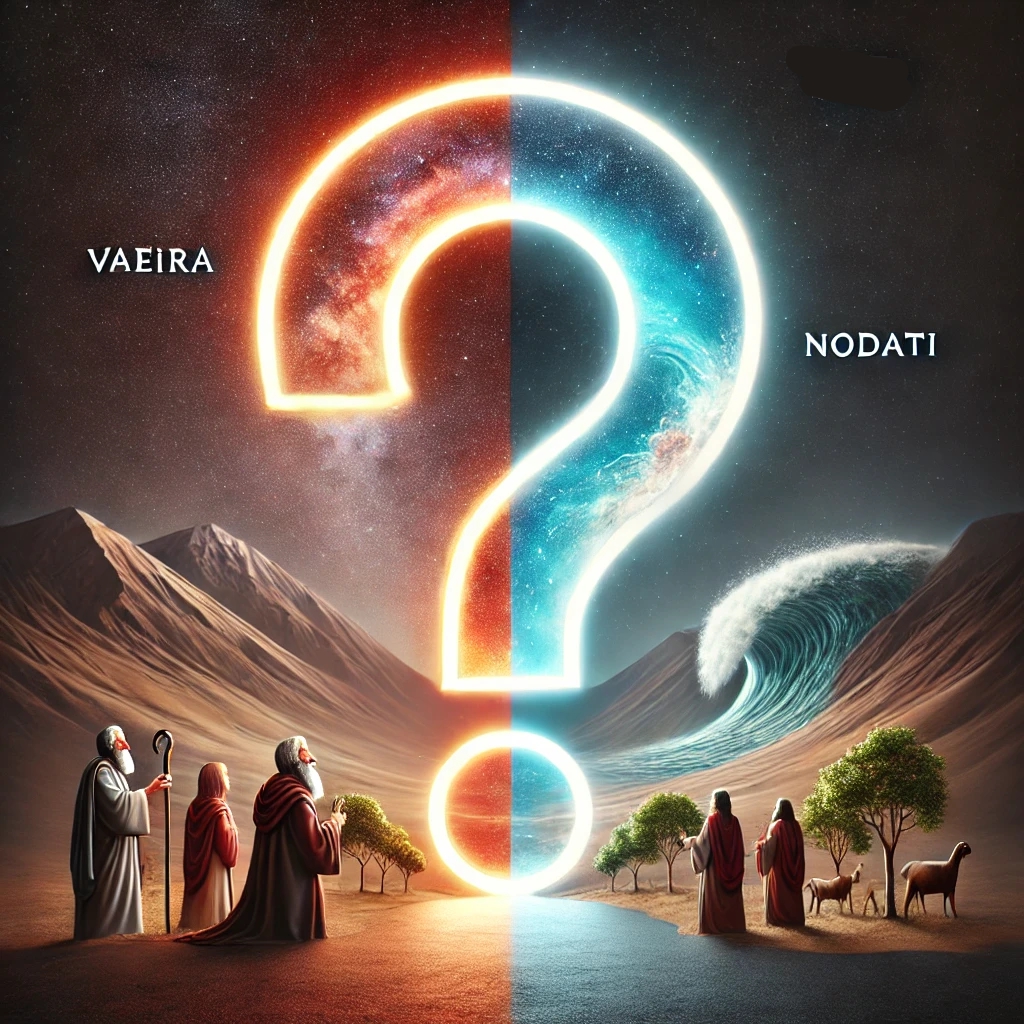
Parsha Va’eira begins, “God [Elohim] spoke to Moses and said to him, ‘I am Hashem [YKVK]. I revealed [Va’eira] Myself to Avraham, Yitzchok, and Yaakov as the Almighty [El Shaddai], but My Name Hashem [YKVK] I did not make known [Nodati] to them.’” (Shemos 6:2-3)
If you’ve been reading the Torah closely, this appears to be a contradiction. The patriarchs, Abraham, Isaac, and Jacob were clearly aware of Hashem’s holiest Name. (It’s so holy we don’t pronounce it as it is spelled — Yud, then Hay, then Vav, then Hay — and for the purposes of respect, I will be referring to it as YKVK.) In Lech Lecha, Hashem says to Abraham “I am YKVK who brought you out of Ur Kasdim” (Bereishis 15:7). When Jacob had his dream of the ladder climbing into Heaven, Hashem said, “I am YKVK, God of Avraham, your father, and God of Yitzchok…” (Bereishis 28:13).
So if the forefathers knew the Name YKVK, how is God’s statement not a contradiction? First off, let’s understand what these Names of God mean.
Elohim – from here on out I will refer to as Elokim
Elokim means Master of all Powers. Often associated with strict justice. God made a system of nature and leaves the world bound by that system. You can also think of Elokim as the ultimate cause and effect.
El Shaddai – from here on out I will refer to as Kel Shakkai
Kel Shakkai means “The God that is Enough.” This is somewhat similar to Elokim in that it is also associated with justice. It, too, refers to God making the rules of nature. Once God made the physical world, there was a point where He said, “this is enough” and limited creation to being finite. Kel Shakkai is used when God makes a covenant with the patriarchs, meaning that it implies a personal relationship.
Adonai – from here I’ll refer to as Adon
Adon means My Master. This one is tricky because it doesn’t necessarily have to refer to God when you see it in the Torah. Also when you see YKVK written, we pronounce it as Adon.
Hashem
Literally means “The Name,” and usually refers to YKVK. YKVK is considered the holiest Name of God and is often referred to as the Tetragrammaton, the Ineffable Name, Havaya, or The Eternal. YKVK is associated with mercy and Hashem doing miracles outside the rules of nature.
There are other Names for God, but for this blog post, this is all that is necessary. The next thing to notice in the quote above is that the text has two different ways of describing awareness of God. “I am Hashem. I revealed [Vaeira] myself… as Kel Shakkai. But… YKVK I did not make known [Nodati] to them.”
The question is, what’s the difference between reveal and know? In English, these would pretty much be synonyms. But there are no synonyms in Hebrew. Vaeira is connected to the root of the word, “to see and understand.” They say seeing is believing, so you might think Vaeira is the most powerful form of God awareness. However, Nodati is from the word Daas, or an experiential knowledge. You could learn everything about ice cream (how to make it, the health benefits, you could manage a Baskin Robbins) but until you taste ice cream, you don’t really know what you’re talking about. That’s the experiential knowledge of Nodati. This leads to the big question, what are Moses and the Jewish people going to experience about God that the patriarchs only got to see?
Paraphrasing Rashi, he essentially says that God made promises to the forefathers when He established His covenants (i.e. their children will become a nation, He will take them out of Egypt with great wealth and bring them to the land of Israel, etc.) But the patriarchs never saw those promises fulfilled. Their relationship was one based on faith. For them, faith was enough. That’s not to say their prayers weren’t answered, they certainly were. But the miracles they experienced were within the confines of nature.
Moses and the Jewish people on the other hand would get to experience the promises of the forefathers becoming fulfilled. Their miracles would be undeniably supernatural (the 10 plagues, splitting of the sea, manna falling from the sky) and ultimately their relationship with God would be based in mercy opposed to judgment. So even though Abraham, Isaac, and Jacob understood God was YKVK, they didn’t experience it.
Today, we have the Name YKVK, but we don’t say it. When we make blessings or read the Torah, we are supposed to have YKVK in mind but we pronounce the Name Adon, My Master. To have one thing in mind, but to say something else… isn’t that itself a contradiction? An act of hypocrisy? Not necessarily. I don’t think we are capable of articulating YKVK because we haven’t experienced Him on the Daas level. The miracles we see today could be explained away by a skeptic.
But in the next verses of Va’eira, God tells Moses how he’s going to save the Jewish people. I will free them, I will release them, I will redeem them, and finally, “I will adopt you as a nation for Me and act as a God [Elokim] for you. You will recognize that it is I, YKVK, your Elokim, who is freeing you from the burdens of Egypt.” (Shemos 6:7) God freed us for the sake of us being His Nation. That responsibility is our service. God is telling the Israelites and us today that if we want to know that Name of God, we have to align ourselves with the purpose of our redemption. So perhaps the reason we utter Adon when we read YKVK is because seeing God as My Master is how we have to view ourselves if we truly want to know a God that is merciful, intimately personal, and will break the “rules” of reality for our good.
 Six Degrees Of Kosher Bacon
excellent blog! Shabbat Shalom
LikeLike