

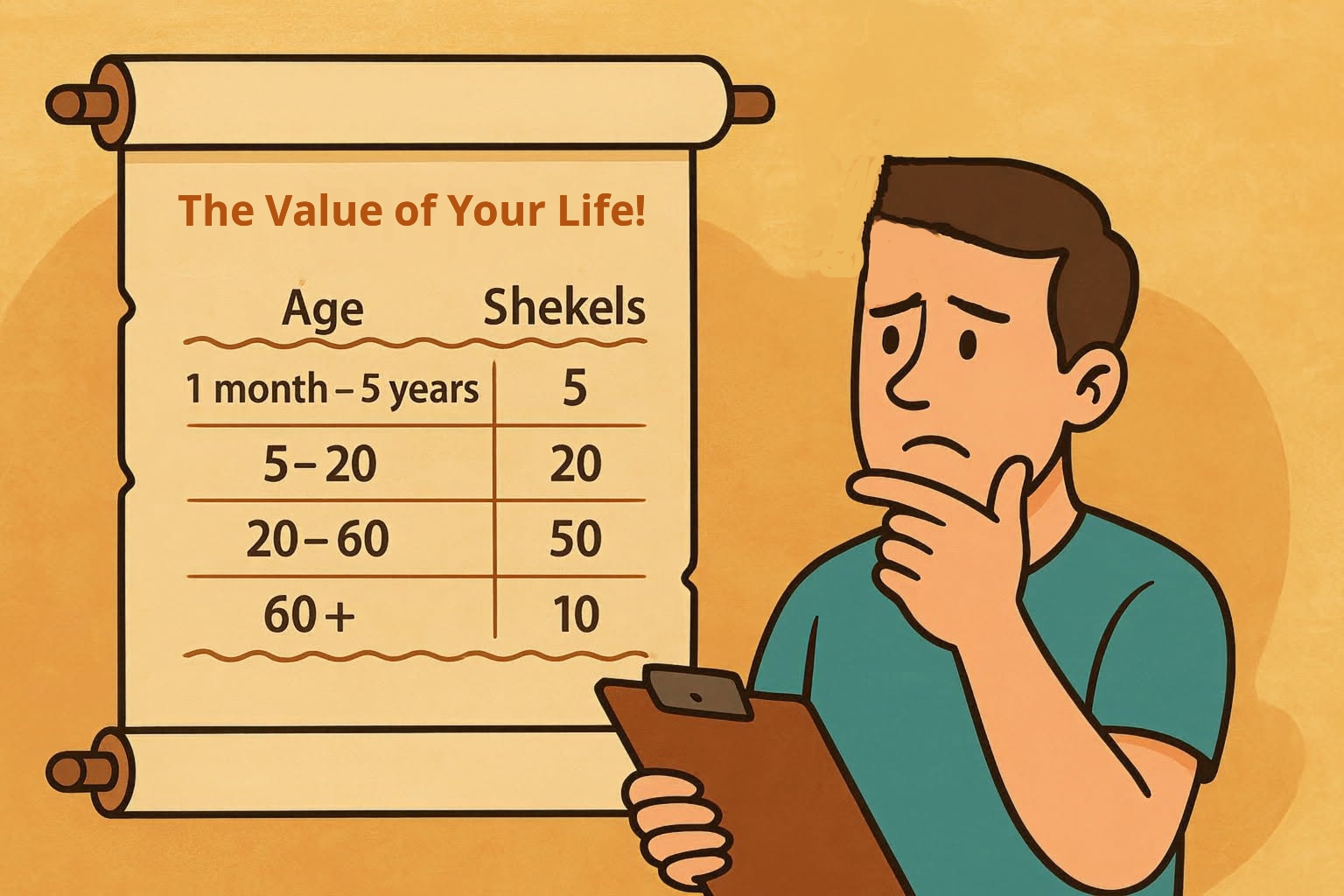
How much is a human life worth? It is a question with no ethical or moral answer. Sure you could calculate the value of various organs on the black market. Eight pints of blood. Maybe sell the hair to some wig maker. But none of that takes into account the earning potential, the emotional value from the person’s relationships, and, of course, the good of this person which may revolutionize the world.
Despite all that, the Torah gives us a nice little table to assess the value of life. (Given age and sex, of course.)
| Amounts in Sheckles | ||
| Age | Men | Women |
| 1 month – 5 years | 5 | 3 |
| 5 – 20 | 20 | 10 |
| 20 – 60 | 50 | 30 |
| 60 + | 15 | 10 |
Yes, in parshas Bechukosai, the Torah flat out lists the monetary worth of individuals vis-à-vis Israel currency, the sheckle. Now, this appraisal is known as arachin and specifically refers to a donation or pledge a person can make to the Temple that is meant to be equivalent to the value of their life. How much would these values be worth in our modern day currency? The ancient sheckle would be worth somewhere between $50-200 USD. So at the minimum a baby is worth $150 and at maximum a man in his prime could go for $12,000, about the price of a decent used car. Nice. But such a cursory and clean cut assessment seems a bit at odds with other ways the Torah views what a life is worth.
In Sanhedrin 74a, a scenario is discussed particularly concerning the comparison of lives. As when a certain person came before Rabba and said to him: The lord of my place, a local official, said to me: Go kill so-and-so, and if not I will kill you, what shall I do? Rabba said to him: It is preferable that he should kill you and you should not kill. Who is to say that your blood is redder than his, that your life is worth more than the one he wants you to kill? Perhaps that man’s blood is redder. This logical reasoning is the basis for the halakha that one may not save his own life by killing another.
Similarly in the Mishneh in Sanhedrin 4:1 we find this teaching… Therefore, Adam was created alone, to teach you that anyone who destroys one soul from the Jewish people, i.e., kills one Jew, the verse ascribes him as if he destroyed an entire world, as Adam was one person, from whom the population of an entire world came forth. And conversely, anyone who sustains one soul from the Jewish people, the verse ascribes him credit as if he sustained an entire world. The mishna cites another reason Adam the first man was created alone: And this was done due to the importance of maintaining peace among people, so that one person will not say to another: My father is greater than your father.
So it would seem that the value of life is either incalculable (i.e. priceless) or at the very least, the value of the entire world. How is it then in Bechukosai, the Torah is equating a life with the cost of a few months’ rent. And on top of that, why the seemingly misogynistic and ageist assessments?
The first clue comes in the Hebrew word for this donation, arachin, the root of which is ayin, reish, chaf. This Hebrew root means “parallel” or “arrange items in juxtaposition” meaning by definition, this concept must be comparative. Why would this pledge of life necessarily require comparison? However, the actual definition of arachin is to estimate a current value. This is a clear indication that whatever value we’re assigning isn’t accurate.
The next clue comes in verse Vayikra 27:8 If the pledger is too poor to pay the endowment, he must present the person before the kohein, and the kohein must evaluate this person in accordance with how much the pledger can afford. Remember, this pledge is completely voluntary. If a person doesn’t have means to make this donation, they are under no obligation. So why would anyone who has difficulty affording such a pledge be making such a sacrifice? Then on top of that, why is this person getting a personal and individualized evaluation of their life? Not an estimation!
I think this all comes together when we consider the nature of this pledge. The Torah discusses this mitzvah after a long list of horrifying curses. The Kli Yakar comments that the reason for this placement is because it is when people are in danger, we make bargains and pledges to God to save us. As the old joke goes, a man was desperate to find a parking space on his way to a job interview. He folded his hands and prayed. “Oh God, I can’t take it anymore. If you give me a parking space, I’ll give up drinking, I’ll stop cursing, I’ll donate to charity with every paycheck, I’ll even start doing community service, and go to church every Sunday.” The next moment, the clouds suddenly parted and a ray of light shone down from the sky, illuminating a parking space right in front of the office building’s entrance. The man parked his car safely in the space and muttered, “Never mind, God. I found one myself.” Once the danger is over, we often forget the vow we made.
So in those moments when we are willing to dedicate our whole lives to Hashem and make pledges we later realize we can’t really afford, the Torah prescribes a price for our life at that moment. Not an in-depth, line-by-line appraisal of achievement and potential, but the societally accepted base price. The Kelley’s blue book value of a totaled vehicle. Men are worth more than women. Old people less so. Children the least. Paying this bounty frees the individual from the life debt and allows them to go on their merry way.
But for the person who sees themselves as poor, who wants to give their life to the Torah and Jewish life, but doesn’t have the means to write a check? That person gets an authentic, calculated, and full appraisal. Yes, they may end up paying fewer sheckles than the rich man, but their desire to make that vow, their authenticity of heart, that’s what God really wants. They want their contribution to be more than the monetary donation. They are willing to make a cheshbon haneffesh, a sincere self evaluation of who they are and where they’re going in life. How do we know? Because they’ve sought out the kohein to make this judgment.
In life, we can always do the prescribed requirements and get by. But only when we’re willing to hash out our flaws and figure out where we truly stand can we properly assess how to get where we want to be going. For this we need a wise and objective guide that will make us face the unpleasant realities of where we’re falling short. It’s only when we do that, our worth can no longer be calculated by a table of statistics and projected earning potential.
 Six Degrees Of Kosher Bacon