

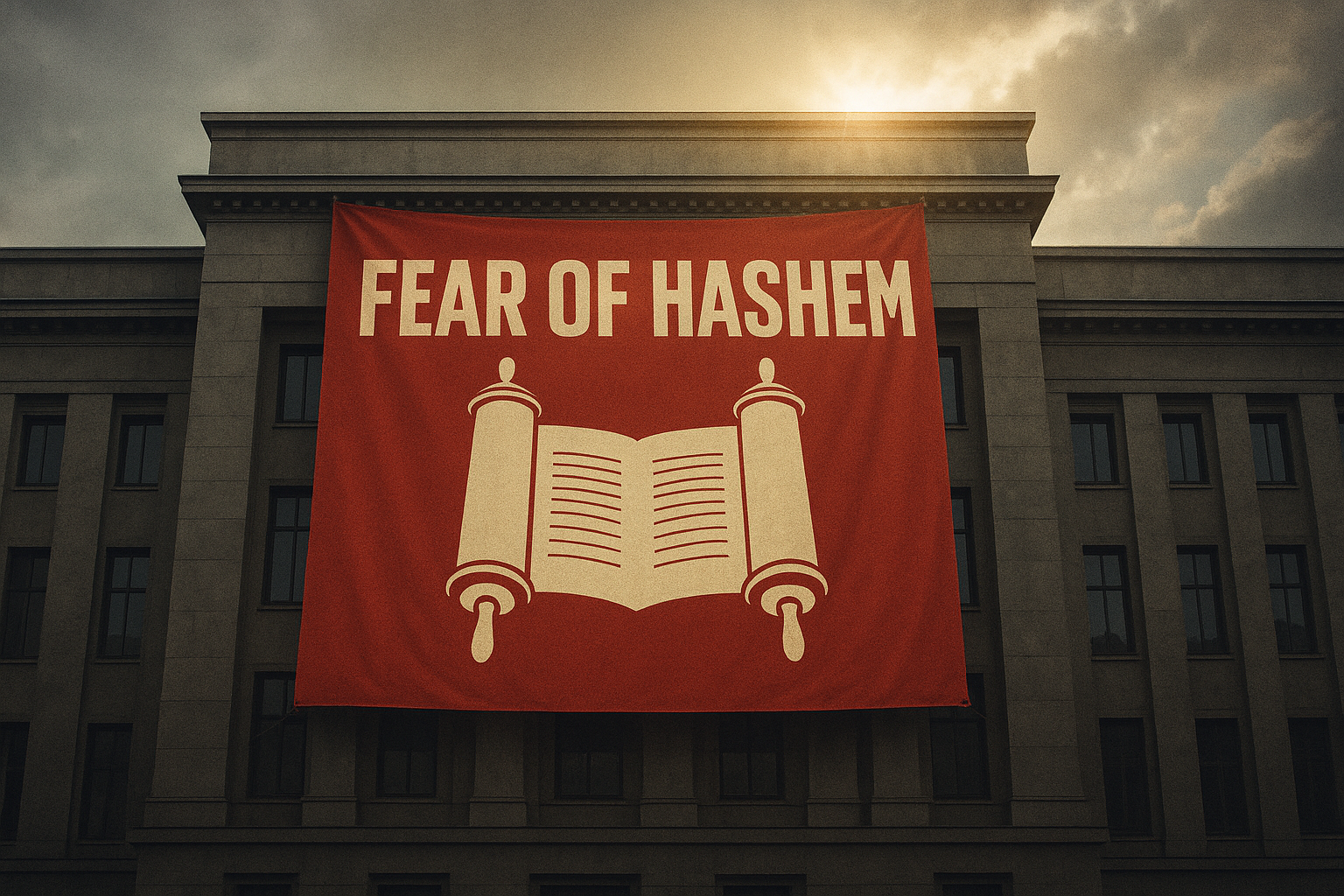
And now, Israel, what does Hashem, your God, demand of you? Only to fear Hashem, your God, to walk in all His ways, to love Him, and to serve Hashem, your God, with all your heart and with all your soul. (10:12)
Nobody wants to live in fear. We think of tyrants, parents saying “spare the rod spoil the child,” and fire and brimstone preachers using it to control. My father used to tell me stories about how in medical school, doctors would embarrass residents and interns, as if they were a piece of metal to heat up and reshape into the doctor’s desired image. “Obey me or suffer” is the tool of dictators, not an all-loving, all-powerful God.
So why is it that in this week’s parsha, Eikev, the first thing God demands of us is “Only to fear Him?” The Torah has no shortage of terrifying curses that will befall the Jewish people should they decide to throw off the yoke of Hashem. Just wait a couple of weeks for parsha Ki Savo if you doubt me. Could the Torah really be about controlling the Jewish people through fear as an authoritarian despot would? What’s the difference between the fear demanded by a dictator and what God is asking of us?
I asked AI how dictators use fear to control people and it gave me criteria. Here are just a few.
1.) Constant Threat of Punishment
In North Korea, citizens can be sent to labor camps for the smallest of infractions. Recently someone smuggled in a copy of Squid Game on a thumb drive. The smuggler was sentenced to death by firing squad, the kid who bought the drive was sentenced to life in prison, and the other kids who watched it were sentenced to five years of hard labor.
In Judaism, yes there can be consequences. But according to Mesilas Yesharim, Hashem eases the punishment in three ways. First, He makes teshuvah (repentance) possible. Secondly, He delays the punishment so a person can reflect, consider, and do teshuvah. Thirdly, Hashem doesn’t actually punish to the extent they deserve. “Divine benevolence accepts a minimum as if it were the maximum.” (Mesillas Yesharim Chapter 4)
2) Cult of Personality
Plastering banners and statues around the country, dictators go to great lengths to establish a god-like stature. In North Korea, families have to keep framed pictures of Kim Jong Un in the home, prominently displayed, and well cleaned otherwise they can face severe punishment. In case of a fire, said picture must be rescued from a fire before anything else, including family members.
In Judaism, we’re forbidden to make ANY images of Hashem at all. Not only are we supposed to question the Torah, the event that merited Jacob be renamed as Israel is that he wrestled with the Divine. Judaism isn’t a cult. Questions are welcomed, we don’t cut off people from their families, and yes we rescue Torah scrolls from disasters, but never over human life.
3) Destroying Interpersonal Trust
Citizens are rewarded for informing on friends and even family. People live in fear of expressing their true feelings even in their homes.
Judaism explicitly forbids talking about anyone else in a negative light, even if it is true, aka lashon hara. Even if you hear lashon hara, you’re forbidden from believing it. Even capital crimes require two witnesses who warn the offender in advance, not back stabbing informers. The system bends toward mercy.
So if “fear of God” is trying to control the way authoritarians do, it doesn’t seem like it would be very effective. So what is fear of God trying to accomplish?
Fear and Wisdom
In King David’s Tehillim (Psalms) 111:10 says, “The beginning of wisdom is fear of Hashem.” In Pirkei Avos chapter 3:21 it says, “If there is no wisdom there is no fear of Hashem, and if there is no fear of Hashem, there is no wisdom.”
The Torah associates fear of God with wisdom. What does one have to do with the other? There are a lot of geniuses who find themselves unfulfilled. Knowledge doesn’t equal happiness. Wisdom, however, is about understanding life, investigating the whys, and finding purpose. In order to do that, you must understand what is important.
In Hebrew, fear of God is yiras Hashem. Yira is connected to the Hebrew word “to see.” Where the popular notion is “people fear what they don’t understand,” the truth is people fear perceived consequences. You’re not afraid of jumping out of a plane because you don’t understand gravity. Seeing consequences is what fear is all about. And that is a very good thing.
It’s when we don’t understand consequences correctly that fear becomes irrational and a barrier to life. Professionals who work with things such as: guns, nuclear power, infectious diseases, lion tamers… they’re experts in their fields. But it doesn’t stop them from doing their job. They have a stronger awareness of just how threatening what they’re handling can be, more so than the uneducated. So they have respect, caution, and they also know exactly what to do to be safe. They have more fear than the average person, but they can do more. They know how to manage great power.
The Covenant and Our Power
Via Hashem’s covenant, He gave the Jewish people access to incredible power. In fact, that’s what much of Parshas Eikev is all about. The second paragraph of shema is given here and it differs from the first paragraph because it details reward and punishment. Moses assures the people if they follow the covenant, Hashem will fight their wars for them. “These nations are more numerous than I, how can I dispossess them?” Do not fear them. Recall what Hashem, your God, did to Pharaoh and to all the Egyptians.” (Devarim 7:17-18) It is that power to change the world which we must have reverence for.
Where a dictator uses fear to make people believe they don’t matter, fear of Hashem is literally the opposite. God is telling us that we are extraordinarily powerful… if we choose to see it. As the gemara in Berachos 33b says, “Everything is in the hands of Heaven except fear of Heaven.” Dictators don’t ask if we will choose to fear them, they insist. Hashem invites you to have reverence for Him.
We’re also commanded to love Hashem. Love without fear either means we aren’t willing to make ourselves vulnerable, we don’t value what we love, or we’re taking it for granted. The things you love the most you protect because you fear you could lose them. That fear doesn’t make us small and compliant. It makes us huge. So does our relationship with Hashem.
Fear of a dictator is about making you small. Fear of God is about making you big. The parsha starts out, “And it will be because you heed these ordinances and safeguard and perform them, that Hashem, your God, will keep the covenant for you, as well as the kindness that He swore to your forefathers.” (7:12) The Hebrew word for because is where our parsha gets its name, eikev. Rashi says eikev also means the heel of a foot because it is referring to the “lesser mitzvahs” people trample on. In essence, Moses is saying if we are careful even with the lesser mitzvahs we will be rewarded with Hashem’s kindness. Because there are no lesser mitzvahs, they’re all important. Everything you do has a consequence. That is true yiras Hashem, fear of God, seeing God in everything! Everything you do matters. Nothing is inconsequential. That is a hard thing to live with. It’s a lot of responsibility. That’s why we have to ask for it. It is up to us. But if we do choose it, well…
R’ Chanina said in the name of R’ Shimon ben Yochai: The Holy One, Blessed is He, has nothing in His treasure house other than a store of the merit of fear of Heaven. As it states; the fear of Hashem that is His treasure. (Isaiah 33:6)
 Six Degrees Of Kosher Bacon