

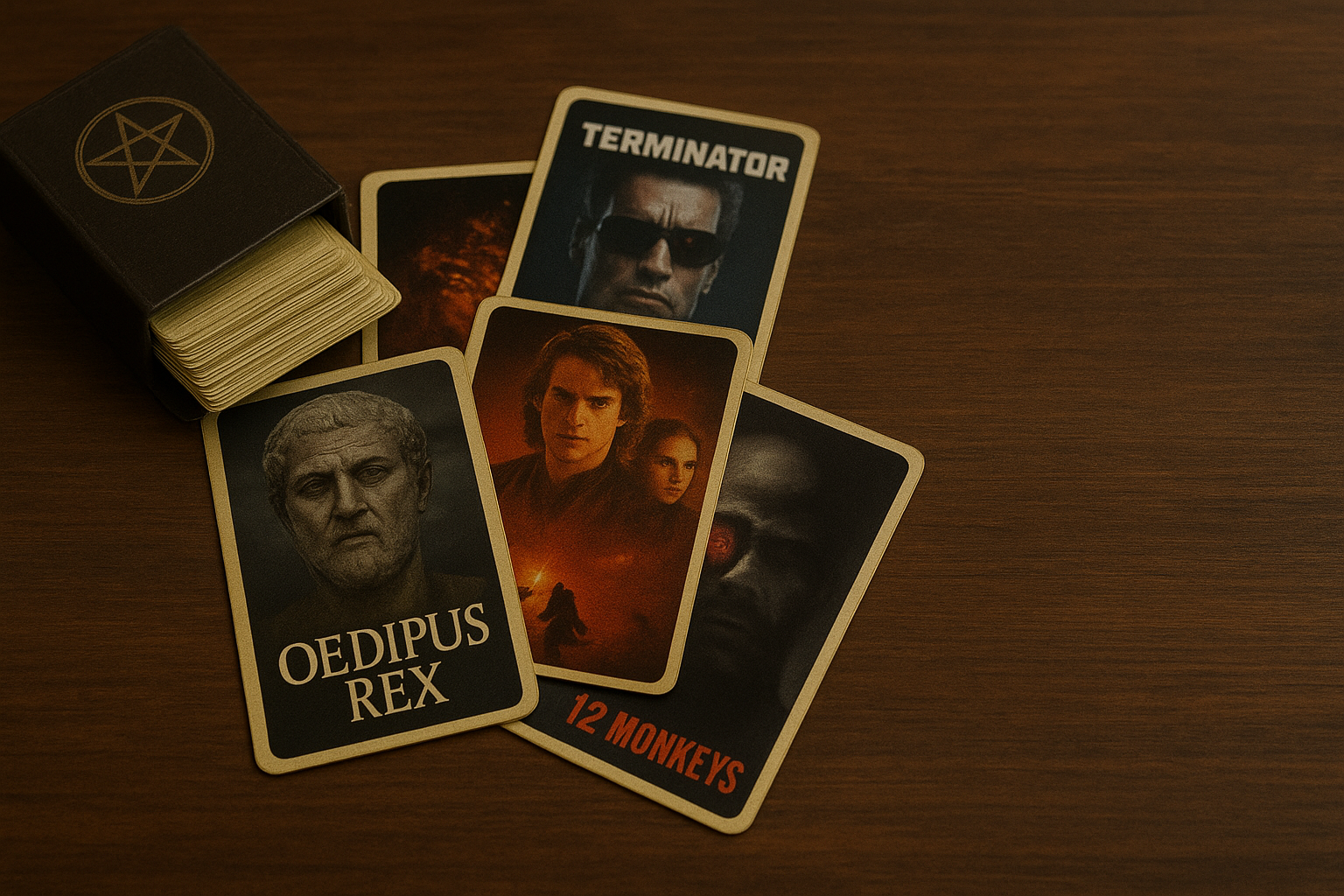
In Oedipus Rex, Oedipus is sent away in the hopes of avoiding a horrible prophecy. The twist? Because of the very steps his parents took, Oedipus ends up unwittingly fulfilling the prophecy anyway. In Terminator, the evil AI Skynet sends a robotic Arnold Schwarzenegger back in time to murder the mother of the future freedom fighter, John Connor. But this actually results in causing John Connor to be born in the first place. In Star Wars: Revenge of the Sith, Anakin Skywalker dreams of his wife, Padme, dying. This sends him on a desperate path leading to him killing her himself!
Kung Fu Panda, 12 Monkeys, Harry Potter, Minority Report and countless others fall into the trope of a character trying to avoid a foretold future only to take the actions that directly send them right to it. So it makes sense the Torah prohibits trying to know the future via methods like horoscopes, fortune tellers, Tarot cards, etc. But it is not because we will inevitably fall into the traps we’re trying to escape.
“You shall be tamim with Hashem, your G-d.” (Devarim 18:13)
Within the midst of prohibiting the consultation of snake charmers, necromancers, and other occult advisors, Shoftim gives us a rather vague mitzvah. What does it mean to be tamim with God and what does it have to do with fortune telling?
Tam can be translated as simple, naive, innocent, whole, or being perfect. In the Passover Seder we refer to the simple son as the tam. He’s usually depicted as aloof or dull, maybe the most childish of the four. The point is, he’s certainly not the wise son. But on the other hand Jacob, the patriarch the Jewish people are most associated with, he’s described as an eish tam, a perfect man. So what is Shoftim asking of us? Are we supposed to be simple before God? Or perfect before Him?
Rashi gives us a nuance that takes the meaning in an interesting direction. “Walk with Him in perfect trust, in anticipation of Him. Do not explore the future, rather accept it with perfect trust. Then you will be with Him and become His portion.”
If you’ve followed this blog for a while, you’ll remember I made a series of posts on Trusting Hashem, aka Bitachon. Bitachon is a relationship with Hashem that transcends faith. With bitachon you don’t just believe everything will eventually work out in the end, instead you rely on Hashem, trusting that whatever is currently happening IS good. Not just good, the best thing that could be happening.
Bitachon is an exceptional level to achieve. Living with bitachon isn’t a mindset, but a behavior, the actualization of faith based on trust. Someone with bitachon never takes more than they need, are happy with what they’re given, and those who surround them feel safe because they know a person with bitachon has no ulterior motive other than what is best for everyone. On a mystical level, they don’t just see the good in reality; what they see in reality turns into good. It’s a remarkable existence. But as I’ve said before, trust isn’t willed, it is built.
The core of bitachon is accepting what is happening in your present life and making the decision to see it as good. So that would be why trying to look into the future is a mindset that is counterproductive to trust. Rooted in insecurity, it is an attempt to calm worries of what’s to come. The methods listed in Shoftim go a step further as they’d be akin to gaming the system. The Torah doesn’t say these methods don’t work, it says don’t do them. So it would be like cheating on a final exam by hacking the teacher’s computer. Not only are you not learning the material, you’re stealing and violating the instructor’s privacy.
When you trust in Hashem, that means understanding He wants what is best for you, even if that is difficult. So your primary goal shouldn’t be to succeed in whatever you are pursuing, but to learn what each situation is presenting you. Most goals based on an outcome are temporary; closing a deal, selling a project, winning a game, even relationships only last so long. But refinement of character, which is really what we’re here for, that’s permanent, as long as you keep pursuing it. And no future outcome can stop you from refining your character, it can only give you new challenges to refine it.
As the Or HaChaim puts it, “You will be complete and at ease with Hashem your G-d provided that you are on the same wavelength as Hashem your G-d. Any evil in store for you which you would find by consulting your horoscope is not bound to happen anyway.”
The Tur HaAroch also says, “Our hearts need to be trained exclusively on Him, and we must believe that He is the ultimate source of all that happens and that therefore reliable knowledge of future events can be obtained only from Him.”
That’s all great to strive for. But why does Rashi end his comment, “Then you will be with Him and become His portion.”? How can we become a portion? When we talk about our portion, we’re usually referring to our reward or what we’ve earned. The Vilna Gaon says in Mishlei that the whole purpose of the Torah is for us to achieve bitachon, trust in Hashem. It is bold to say Hashem “wants” anything. But if He gave us the Torah, there must be an objective, a goal, whatever that means for an Infinite Creator. So if us achieving bitachon is why He gave us the Torah, then when we work to attain it, that would be the portion Hashem is seeking.
A good story doesn’t necessarily have to have an unpredictable ending. The good guys are probably going to win, the hero is probably going to get the girl, the villain is probably going to meet their demise. But it is how it happens, how the hero overcomes their insurmountable odds, how imaginative the romantic gesture wins the heart, that we remember. When you have bitachon you don’t have to cheat to know how the future is going to turn out. We already know from prophecy. It is going to be difficult, but in the end it will be good. But if you actually trust it, then you can act like it. You may come off as simple, naive, innocent, but you will also be perfect while living in the present.
 Six Degrees Of Kosher Bacon
I always love seeing something from the Ohr HaChaim. Thank you!!!
LikeLiked by 1 person
Beautiful!
LikeLiked by 1 person