

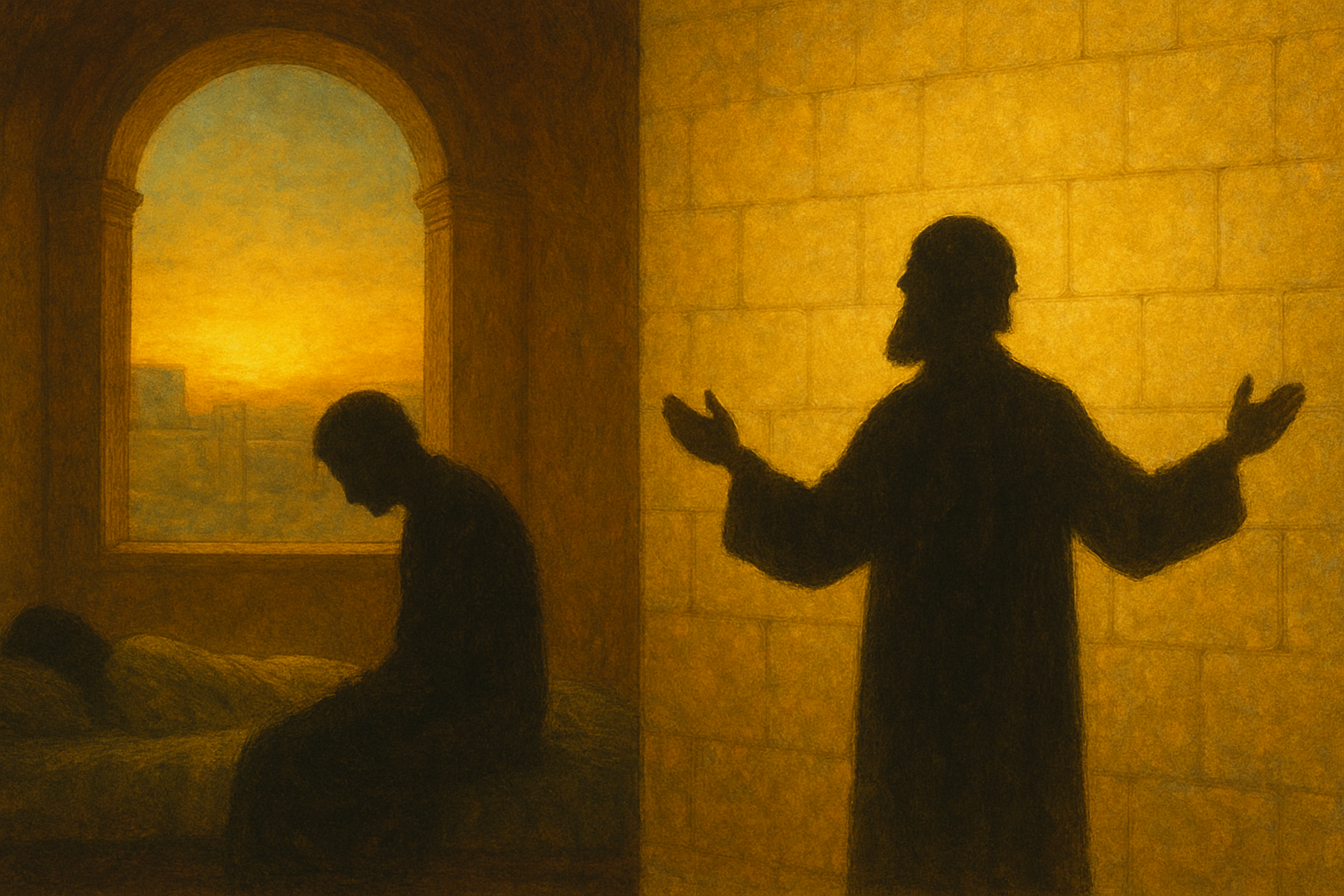
One of the most disturbing stories in the whole Torah is the tragedy of Dina and Shechem. Dina goes out into the city of Shechem and is abducted by the prince (who is also named Shechem). Shechem has his way with her, but after the assault, decides he wants to marry her. So his father Chamor tries to arrange their marriage with Yaakov. Shimon and Levi take over the negotiations and insist that every man in the city gets a bris milah (circumcision). Then three days later Shimon and Levi slaughter all the men and rescue their sister Dina.
It is a bizarre and troubling story to say the least. But what if I told you that within Shechem, this spoiled, arrogant, rapist was the root soul of none other than Rabbi Akiva? How could one of Judaism’s most honored, brilliant, and legendary rabbis even be associated with such a perverted criminal?
I’ve always thought it odd that Shechem’s father’s name is Chamor, which literally means donkey. Now just because the Torah names a character something doesn’t necessarily mean that was their actual name. Even Moses’ real name may have been Avigdor, or Yered, or Yekusiel. So where does Chamor get his name? It may have come from a Midrash (Midrash Tanchuma, Vayishlach) in which Yaakov and Chamor discuss the Dina situation. Chamor says to him, “Your grandfather Avraham was a nasi (prince, lord, leader). I’m the governor of the city of Shechem. The marriage between my son and your daughter makes sense.” Yaakov replies, “No, Avraham was not called a nasi, he was called an ox. And you’re a donkey. There’s no plowing with an ox and a donkey together.” (There’s a mitzvah in Devarim 22:10 “Do not plow with an ox and a donkey together.”)
What’s Yaakov doing referring to his grandfather as cattle and the man in front of him as literally an ass? The Ksav Sofer of Pressburg elucidates this comparison by referring to a verse in the book of Isaiah, “An Ox knows his owner, a donkey knows the trough of his master.” (1:3) According to Jewish thought, an Ox is considered the king of the domesticated animals. Its strength is unparalleled and has been the preferred animal for virtually all field work, especially heavy labor. But oxen also are relatively easy to domesticate, thus it serves its owner. In such a way, Avraham was like an ox. He had incredible strength (he single-handedly won a world war) but his aim wasn’t for a personal reward, but instead a closeness with Hashem. He knew his owner and he worked to serve Hashem.
A donkey on the other hand, “knows the trough” means it’s only concerned with its reward. During the binding of Isaac story, Avraham leaves behind his attendants. “He saw the place from the distance and Avraham said to the young men with him, ‘Stay here with the donkey. The lad and I will bow, and return to you.” (Bereishis 22:5) The Talmud (Kiddushin 68a) says “with the donkey” should be read “people of the donkey” implying that the two attendants (some say they were Yishmael and Eliezer) weren’t serving Hashem for Hashem’s sake but for personal reasons. Probably the most famous donkey in the Torah is the animal of Bilaam, the wicked prophet. It’s very clear from that story Bilaam was in it for himself and so his association with a donkey makes perfect sense.
Yaakov isn’t trying to insult Chamor, but instead making clear that the perspectives of their families are incompatible and the marriage will never work. But despite that mismatch, Shechem had a tremendous passion for Dina. The Torah says Shechem cleaved to her (d’vekes), he loved her (ahavah), and he desired her (chaphetz.) According to Rabbi Shimshon of Astropoli, “Whenever you see someone desiring something very strongly, it’s never just negative, there’s something very deep and holy inside of them that wants it. Shechem’s craving for Dina wasn’t just vanity. There was something deeper going on.” When people get overwhelmed with their base desire, once they indulge, they usually regret it and want nothing to do with it. In the book of Samuel, Amnon becomes infatuated with his half sister Tamar and forces himself on her. But immediately after the act, Amnon’s lust turns to hatred. But, here with Shechem the opposite happens, he grows more fond of her. It’s from this idea that Rabbi Shimshon says that Shechem had within him the root of the soul of Rabbi Akiva and that Dina’s holiness awakened Shechem’s own desire for holiness.
Before Rabbi Akiva was a rabbi, he was an unlearned field worker (an am ha’aretz). He, too, met a holy woman who awakened something holy within him. Because of his wife, Rachel, he went off to learn for decades to become one of the greatest sages Judaism has ever known. But Rabbi Akiva is quoted as saying, “When I was an am ha’aretz, I hated Torah scholars with such a passion that I wanted to bite them like a donkey.” Why a donkey? Why not a fox or a dog or a bear? Rabbi Shimshon Astropoler says this is another connection to Rabbi Akiva being Shechem. When Shimon and Levi slay all the men of the town, they have them first do bris milah. This is a war tactic so the men will be weak when they attack. However, they still performed a holy act and went through a pseudo-conversion. According to the Rema of Pano, those men numbered 24,000. When do we see 24,000 men also die? The 24,000 students of Rabbi Akiva died during a plague. So according to Rema of Pano, the men of Shechem were reincarnated into Rabbi Akiva’s students. And why does the Talmud say the students died in the plague? Because they did not show proper honor to their fellow students. Meaning they were arrogant. They knew the trough, not the master.
So what does it mean that Rabbi Akiva shared a soul with Shechem? What did he fix or elevate that Shechem never did? Shechem had this tremendous passion for Dina. He had ahava (love), chaphetz (desire), and d’vekes (cleaving). Rabbi Akiva had the very same passion, but his was for Torah and Hashem. He inspired 24,000 men to become great scholars and after they died, he started again. His next students were Rabbi Meir, Rabbi Shimon bar Yochai, Rabbi Yehuda bar Ilai, Rabbi Yosef ben Halafta, and Rabbi Elazar ben Shammua, the five men who would ensure Judaism would continue after horrible Roman persecution. Another overlap between the two men lies in the brutality of their deaths. The Talmud in Berachos (61b) relates the story of Rabbi Akiva’s death.
When they took Rabbi Akiva out to be executed, it was time for the recitation of Shema. And they were raking his flesh with iron combs, and he was reciting Shema, thereby accepting upon himself the yoke of Heaven. His students said to him: Our teacher, even now, as you suffer, you recite Shema? He said to them: All my days I have been troubled by the verse: With all your soul, meaning: Even if God takes your soul. I said to myself: When will the opportunity be afforded me to fulfill this verse? Now that it has been afforded me, shall I not fulfill it? He prolonged his uttering of the word: One [Echad], until his soul left his body as he uttered his final word: One [Echad]. A voice descended from heaven and said: Happy are you, Rabbi Akiva, that your soul left your body as you uttered: One [Echad].
Rabbi Akiva strived his whole life to express his love for Hashem in the most profound and powerful way. Beyond anyone else who had ever lived. But why is the fact that Rabbi Akiva’s final word was “Echad” emphasized? According to Rabbi Astropoler, Echad is spelled aleph, chet, dalet. These letters represent the ahava (aleph), chaphetz (chet), and d’vekes (dalet) of Shechem’s passion being elevated for its holiest purpose. Rabbi Akiva took the basest desires, which in the wrong hands, can lead to something as horrible as rape, and sublimated it to the purest and most powerful love of Hashem.
We all have done things we regret and we all have parts of our nature that we’re not proud of. But from Rabbi Akiva we learn that every dark inclination in our hearts is rooted in kedusha because every person is a spark of Hashem. No matter who we are or what we’ve done, we have the potential to be among the greatest of our generation, or of any generation.
This post was inspired by a d’var Torah given by Rabbi YY Jacobson. Please watch it for even more details and profound insights. This blog post is dedicated to the aliyah of the neshama of Yochanan ben Baruch.
 Six Degrees Of Kosher Bacon