

In Finland, it’s possible to get a speeding ticket for hundreds of thousands of dollars… if you’re rich. That’s because in most Scandinavian countries, a person’s income is factored into the price of the ticket. On one hand it seems like a profound injustice to have two people get different penalties for the same crime. But if a monetary penalty is supposed to function as a deterrent, wouldn’t a fixed fine inherently be less of a deterrent to a rich person compared to a poor person? (Not to mention the cost of legal counsel and biases already in the system.) If time is money and you’ve got a meeting where you’re going to make a million dollars, and you can’t find a spot… why would you care if you get a $350 ticket for parking in a handicapped space?
…if there is a fatality, you shall give a life for a life, an eye for an eye, a tooth for a tooth, a hand for a hand, a foot for a foot, a burn for a burn, a wound for a wound, a bruise for a bruise. (Shemos 21: 23- 25.)
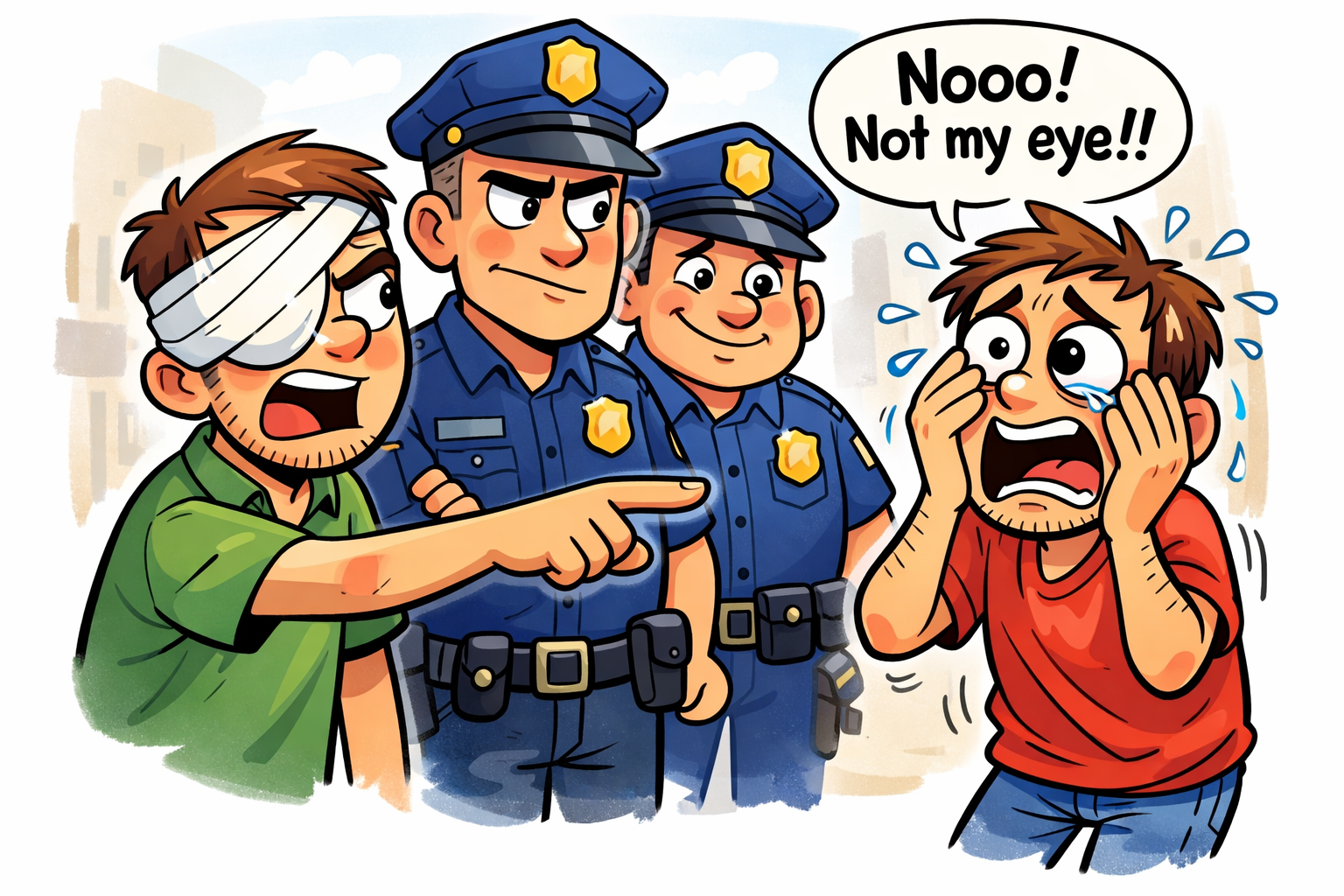
If you look in this week’s Torah portion, Mishpatim, we get the infamous “eye for an eye” verse. For centuries, people have interpreted this line as a justification for revenge. Gandhi is quoted as saying the famous misinterpretation, “An eye for an eye makes the whole world blind.” It’s hard to look at this line and not think the Torah is prescribing barbaric punishment. But what if this line is completely misunderstood? What if its strict justice was actually just as nuanced as the Finish speeding ticket?
Give and Take
The Or HaChaim points out that the phrase, “you shall give a life for a life” is not how the Torah refers to the death penalty. Just a few verses earlier the parsha talks about punishing a murderer, “Anyone who strikes a man so that he dies must be put to death.” No mention of “giving the life.” Regarding the prohibition of child sacrifices, in Vayikra 20:2 it says “[Anyone] who gives any of his offspring to Molech, shall surely be put to death; the people of the land shall pelt him with stones.” There’s no other place in the Torah where “giving a life” is used for capital punishment. The Or HaChaim says, “the precise wording of [g the Torah’s] statement ‘you shall give’ is well understood for [money] is something that is given from one hand to another.” You can take a life, but you can’t force someone to give a life via an execution.
What for What
It’s also important to look at the word “for” in the verse. The Hebrew word is “tachas,” which means, “in the place of.” Poking your eye doesn’t replace the eye that was lost. Does money? No. But what “tachas” does imply is a unique value of the loss. If you break someone’s hand, you’re responsible to pay for medical fees but also lost wages. If the person is a teacher, they may only miss a day of work. But what if they are a concert pianist with sold out shows for the next month? There’s quite a bit more you’re going to have to pay to make that right. That’s the specific compensation the Torah demands. In that case, breaking your hand does little to solve the victims problem.
Minimizing Damages
Whether Finland’s way of dispensing traffic fines is just or practical is a debate for their government. But there is a difference between their system and what the Torah demands. Finland asks: What will make this hurt equally? Torah asks: What will restore what was taken?
We live in a world where corporations can break laws, make billions, and pay penalties that amount to a fraction of their profit. Class action settlements often return pennies to victims who suffered real and lasting harm. The Torah’s model insists on something deeper. Even when a loss can never truly be replaced, justice demands that we approximate its value as closely as possible.
No one needs to lose an eye to see that. It’s not about revenge. It’s about making things right.
 Six Degrees Of Kosher Bacon