

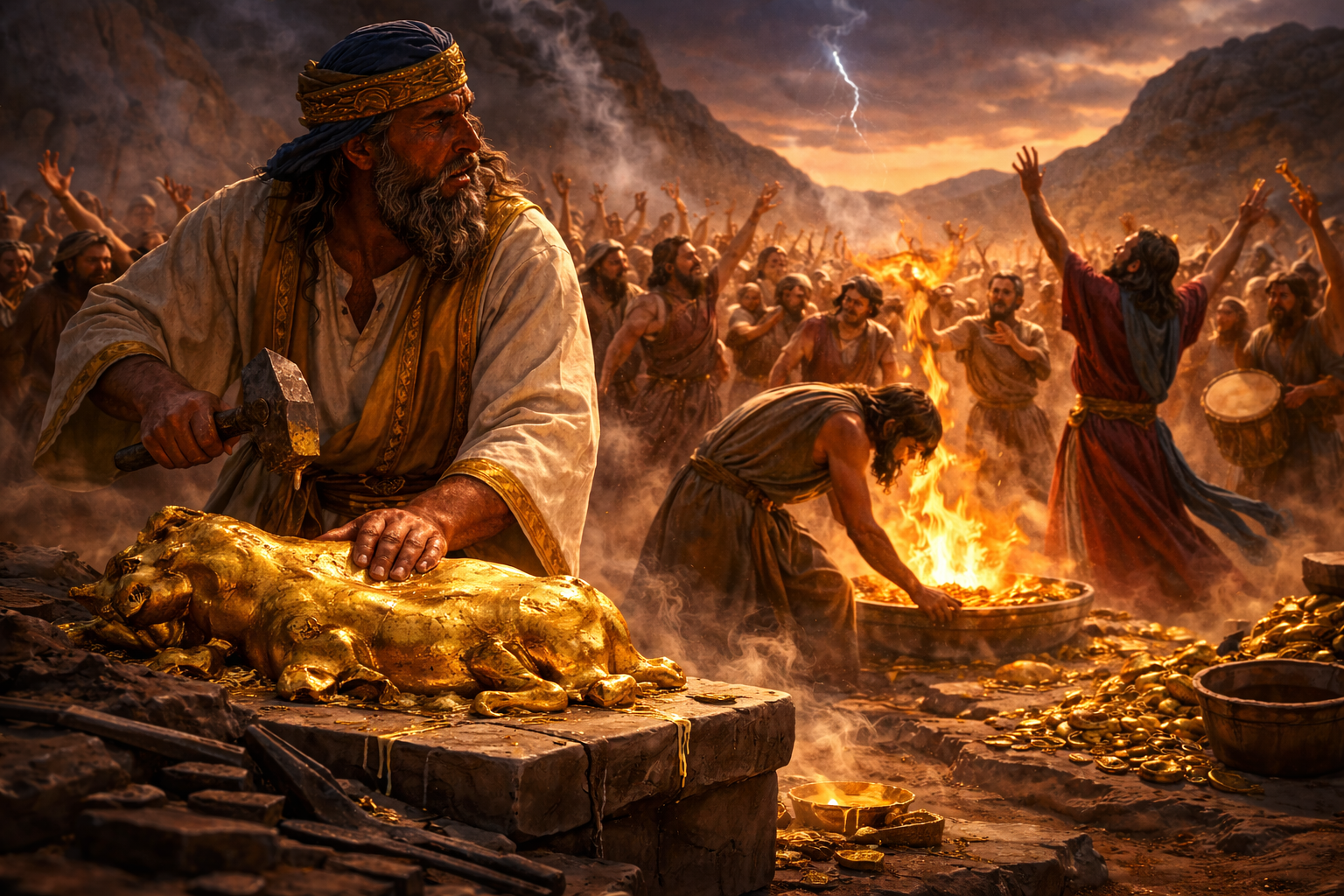
“The people saw that Moshe was late in coming down from the mountain, they gathered against Aharon and said to him, ‘Arise, make us gods that will lead us…’” (Shemos 32:1)
At the beginning of the Golden Calf incident, the people confront Aharon and pressure him to make an idol of gold. He delays, he deflects, and he tries to make peace. But ultimately things get out of hand and before he knows it, the people are committing avodah zara (idol worship).
For Aharon’s part in facilitating the ordeal, we learn from Rashi on Vayikra 10:12 and Devarim 9:20 that he is held accountable and that all four of his sons were supposed to die because of it. What should Aharon have done? Taken a hardline objection to the crowd? At the end of Mishpatim (Shemos 24:14) Aharon and Chur (Miriam’s son) were left in charge. However, in this week’s parsha, Ki Sisa, Chur is nowhere to be found. According to the Midrash, Chur objected and the crowd killed him.
“When Israel performed that act, initially they approached Chur. They said to him: ‘Rise, craft for us a god.’ When he did not heed them, they stood against him and killed him… Afterward, they approached Aharon. They said to him: ‘Rise, craft for us a god.’ When Aharon heard this, he was immediately afraid. That is what is written: ‘Aharon saw and he built an altar before him”’(Shemos 32:5); he was afraid due to the one slaughtered before him. Aharon said: What shall I do? They killed Chur, who was a prophet. Now, if they kill me, as I am a priest, the verse that is written will be realized in their regard: ‘If a priest and a prophet will be killed in the Sanctuary of the Lord’ (Lamentations 2:20), and they will be immediately exiled.” (Vayikra Rabbah 10)
Aharon is stuck between a rock and a hard place. On one hand, he can help the people commit the greatest sin the Jewish people have ever been guilty of, but at least try to minimize the damage while waiting for Moses to return. Or he can lay down his life in objection, and in doing so make the Jewish people irredeemable. What should Aharon have done?
The gemara in Sanhedrin (6b-7a) discusses Aharon’s mindset during the incident. But before it does, it has a discussion about something known as botze’a. Botze’a means compromise or mediation. The gemara compares Moses and Aharon saying “for Moses, Let the [strict] judgement pierce the mountain.” Meaning that nothing should stand in the way of applying the letter of the law. “But Aharon was a lover of peace and a pursuer of peace, and he would apply peace between one person and the other, as it is stated: ‘The law of truth was in his mouth, and unrighteousness was not found in his lips; he walked with Me in peace and uprightness, and turned many away from sin.’” (Malachi 2:6). Meaning that Aharon felt it was more constructive to find a compromise to solve problems and in doing so may have been more effective reaching people.
From here the gemara debates if it is appropriate, a mitzvah, or even a sin to find a compromise instead of going with the strict letter of the law. It starts with one case where someone steals grain but then donates some of the bread they made with it. To that the gemara says, “He is not blessing; rather, he is cursing God.” You can’t break the law, then use the proceeds to do charity. It’s as if that person “despises Hashem.” After a bit more back and forth exploring the limits of botze’a, it mentions the following point: “If two litigants come before you for a judgment…after you hear their statements but you do not yet know where the judgment is leaning, … you are permitted to say to them: Go out and mediate. But after you hear their statements and you know where the judgment is leaning, you are not permitted to say to them: Go out and mediate … Before the resolution of the contention is revealed, you can cast it off. Once the resolution of the contention is revealed, you cannot cast it off.” Meaning once it is clear how the Torah would rule in the case, you can’t mediate. The law is binding.
The Gemara reiterates this ruling then immediately goes into the section about Aharon deciding to build the Golden Calf. “Aharon said to himself: If I do not listen to them now, they will do to me as they did to Chur, and the verse: “Shall the priest and the prophet be slain in the sanctuary of the Lord?” (Lamentations 2:20), will be fulfilled through me, and they will never have a remedy for such a sin. It is better for them to worship the calf, as it is possible they will have a remedy through teshuvah.”
Aharon makes a tremendous compromise. Which is appropriate because as the gemara said above, Aharon was all about compromise for the sake of peace. Bending the rules to make everyone happy. In fact, he may have saved the entire Jewish people from permanent exile. But according to the gemara, there’s a problem. After experiencing Hashem speaking the 10 Commandments, it is clear to everyone that building the calf is wrong. The resolution is clear, no compromise can be allowed.
This was Aharon’s mistake.
Some say that the Torah is unjustly scrupulous when it punishes. Moses is barred from entering Israel for hitting a rock. Joseph had to stay two additional years in prison for asking the wine steward to remember him. Miriam is afflicted with tzora’as for merely talking about her brother’s separation from his wife. But what these bible critics don’t understand is that Torah figures are at the top of their game when it comes to their character traits. They are put in precise situations to test whether the essence of their souls have mastered their human frailty or not. By overcoming your base inclination on the microscopic level, humanity has the potential to not just become angelic, but surpass angels to become God-like. But in order to transcend to such a level, you have to go through the most heart-wrenching dilemma to actually make the choice.
Aharon, the champion of mediation, love, and peace had to be put in a situation which tests the very limits of compromise. He needed to recognize that once the law was decided, there was no wiggle room. If that meant his death and the exile of the Jewish people, so be it. Avodah zara is one of the three sins you have to die for rather than transgress. Clearly, the Torah isn’t saying compromise is wrong. In fact, sometimes it is a mitzvah. But when you try to make everyone happy, you end up making no one happy. Sometimes, you have to put your foot down. And sometimes, being the master of your gift is knowing when not to use it.
Hillel tells us to be “students of Aharon, loving peace and pursuing peace.” But Ki Sisa reminds us that even the greatest lover of peace must sometimes recognize the moment when peace cannot be found through compromise.
 Six Degrees Of Kosher Bacon
Great lesson!
LikeLiked by 1 person