

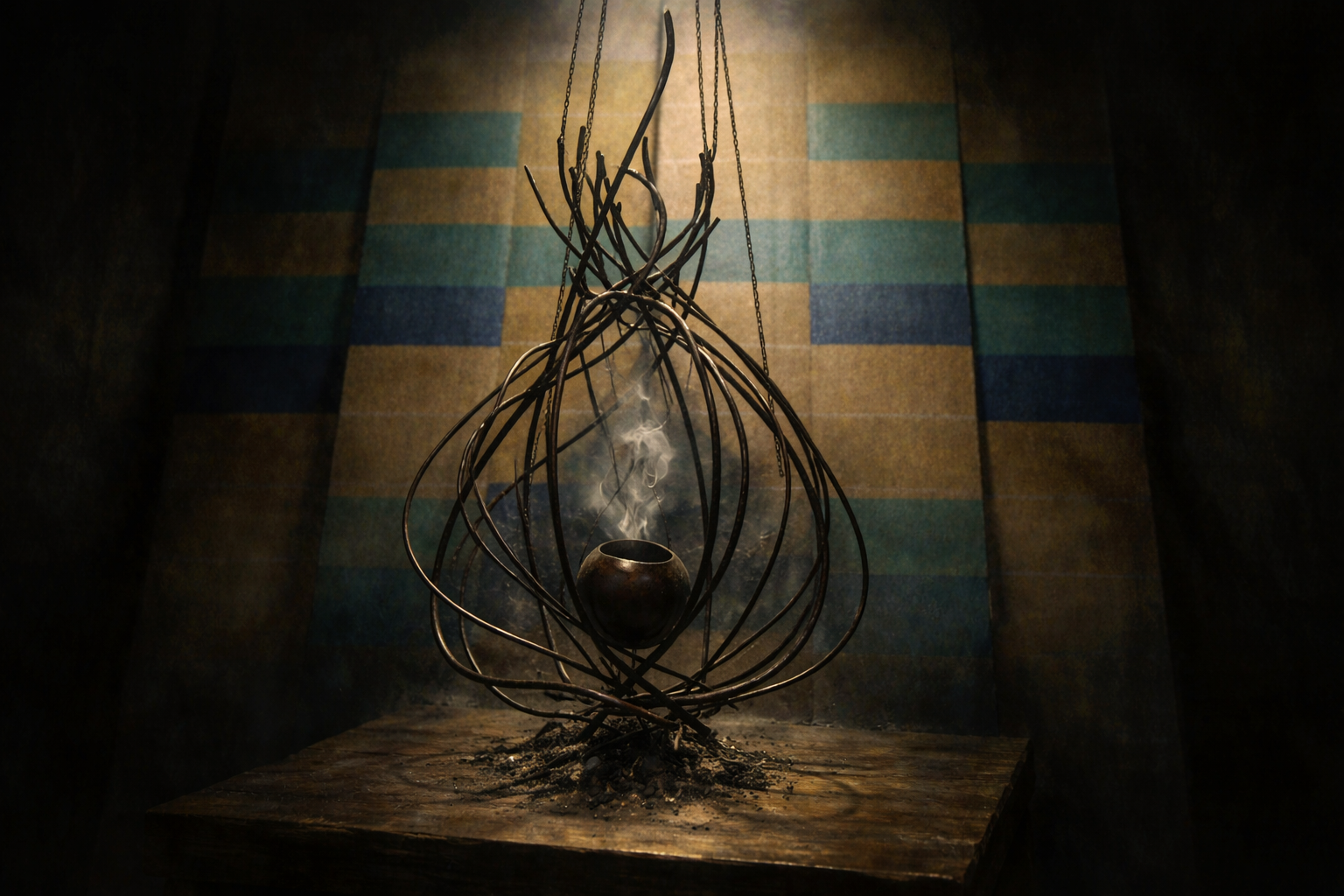
A continuous fire [Aish Tamid] shall burn upon the altar; it shall not go out. (Vayikra 6:6)
My synagogue growing up had a magnificent abstract metalwork sculpture of the Eternal Flame that hung over the bimah. In the center of the bent steel rods was an actual flame that was to never go out. But one day, I found the sculpture had been lowered to the ground and the flame extinguished. Like a child learning about the truth of the tooth fairy, I realized that perhaps much about my religion might be more legend than fact. It would be decades before I would learn that there was something beyond literal truth and legend, but a deeper truth that revealed the human condition.
Not to be confused with the Menorah, the Aish Tamid was a pyre on the exterior copper altar for animal offerings. But as Rashi points out, the menorah was kindled from this fire, so there is some confusion when the menorah is referred to as “tamid” as well. Now, the actual Aish Tamid eventually did go out after 116 years. But considering the Mishkan was a portable Temple that moved throughout the wilderness then to Gilgal, Nov, and Givon, it’s quite a feat that the Israelites were able to keep the fire going through all those travels.
It is well known that every part of the Mishkan/Temple corresponded to a part of a human being. This is alluded to in the verse from in Shemos (25:8) “And they shall make Me a sanctuary and I will dwell in their midst.” Don’t translate it “in their midst” but “I will dwell in them.” Everyone of us is a Temple to Hashem. The altar upon which the Aish Tamid burned corresponded to the heart. But there were two altars: the copper one outside for animal offerings and a golden one on the inside for incense offerings. But obviously, humans don’t have two hearts. The Lubavitcher Rebbe offers the insight that there are two levels to the human heart. The inner level is our essential and subconscious core. While the outer level is our open and revealed behaviors, attitudes, and personalities.
Clearly one of these two hearts are more within our control to change. The outer altar, where the Aish Tamid burned, represented our outer level of the heart. If you don’t love the idea of an animal sacrifice and I don’t blame you. But reasons for the offerings, to rectify your mistakes, offer gratitude, make peace, and repair your connection with the Creator, are noble and holy. Assuming your motivation for the sacrifice is sincere. If not, well sadly that animal may have died for nothing. You had to put your heart into it. Hence why the altar corresponds to the heart.
According to the Talmud in Yoma 21b, the gemara says, “Although fire comes down from Heaven, it is a commandment also for man to bring fire.” What does that mean? A fire would descend from Heaven and consume the offering. A literal and open miracle on a twice daily basis. But the Kohanim were still commanded to add the fire anyway. Why? On this the Lubavitcher Rebbe said, “It was the awakening from below that brought an answering response from Hashem.”
If the Aish Tamid represents the heart and our prayer service is the substitution for the sacrifices, that means we have to bring the fire. Routine, mechanical, and phoned-in prayers aren’t going to cut it. The Torah is teaching us that our hearts must be fed daily. Otherwise we’re bound to feel spiritually empty. The animal is no longer the sacrifice burned on the altar. Now it’s the heart. The process doesn’t work if it isn’t on fire with passion.
 Six Degrees Of Kosher Bacon