

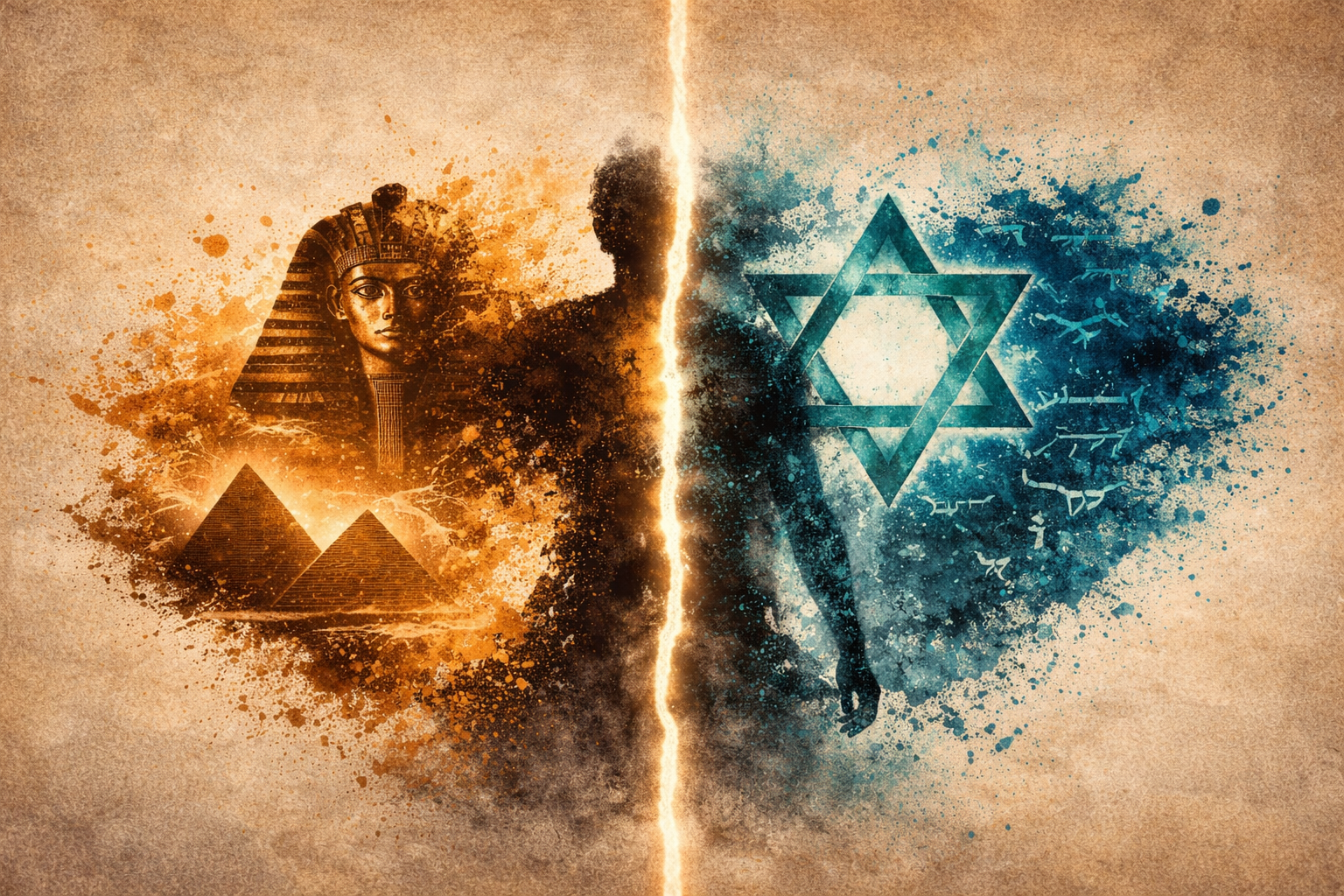
The desire to assimilate is probably the most difficult temptation any Jew faces living in America today. On one hand, we want to be a part of the culture around us and not seen as anything less or different. On the other hand, we feel some sort of responsibility to carry on that heritage that was handed over to us, albeit possibly because of responsibility, guilt, or some fondness from something in childhood. We may think this conflict of identity is unique to our generation, but the truth is, the dilemma dates all the way back to ancient Egypt, starting with this week’s parsha, Shemos.
At this point, the Hebrews have been in Egypt for a few generations and have assimilated into Egyptian society. Pharaoh, feeling threatened by their numbers, institutes decrees reducing them to the status of slaves. Still threatened, Pharaoh calls for the death of all Hebrew newborn males. Yocheved, a Hebrew slave, having recently given birth, puts her son in a basket and sets him in the Nile River in hopes for his salvation. Obviously, this is Moses. He’s found by the daughter of Pharaoh and he is raised as a prince of Egypt.
Then the narrative immediately jumps to Moses in adulthood, seeing the plight of his people. One day he witnesses an Egyptian mercilessly beating a Hebrew slave. Moses kills the attacker and that decision starts a chain of events which will lead to Moses abandoning his princely status, escaping into the desert, and eventually becoming the savior and leader of the Children of Israel. So what drove Moses to take this drastic action and kill the Egyptian? There’s an odd phrase in the Hebrew that clues us into the dilemma on a far more psychological level.
Shemos 2:11-12
Now it came to pass in those days that Moses grew up and went out to his brothers and looked at their burdens, and he saw an Egyptian man striking a Hebrew man of his brothers. He turned this way and that way, and he saw that there was no man; so he struck the Egyptian and hid him in the sand.
The simple understanding is that Moses couldn’t bear to see his brother being beaten. He looked around, saw the coast was clear, then saved him. But what’s with, “He turned this way and that way.” What a weird way to say he looked around. The Hebrew for “this way and that way” is coh veh coh. But coh veh coh isn’t a directional language. The more literal translation would be “he looked such as and such as.”
Rabbi Shalom Denbo made the following insight. When Moses looks “this way and that way,” he’s looking internally at his dual identity. I look one way and I see myself as an Egyptian and I look another way and I see myself as a Jew. Then Moses realizes this internal struggle is being played out in front of him. His two sides are fighting and his Egyptian side winning. In fact, it’s killing his Jewish side. “And he saw that there was no man.” It is at that moment that Moses understood that if I don’t stand up for who I am, then who I am will be destroyed.
Now More Than Ever
At the time of this writing, it’s been a little over two years since October 7, 2023 and even with the war over, antisemitism has skyrocketed across the world. The tragedy of Bondi Beach is still fresh in our minds and protections for Jews in New York City, of all places, are being removed from legislation. But most troubling is the question being posed, “Are you a Zionist?” The thinly disguised litmus test forces us to answer where our loyalties are.
For those of us that have grown up with a strong, proud Jewish identity, hopefully that answer is clear. But for the younger generation who maybe haven’t found what is so special about their Jewish heritage, culture, and religion… Why wouldn’t they hide or reject their Judaism for the benefits of assimilating? According to a Times of Israel article, “Some 78% of Jewish students now conceal their religious identity and 81% hide their Zionist identity on campus, according to a survey of 1,727 students in more than 60 countries conducted during the 2024–2025 academic year by the Anti-Defamation League (ADL) and the World Union of Jewish Students (WUJS).”
Jews shouldn’t have to hide their identity and we certainly shouldn’t ever be put on the spot to choose. But regardless of what should be, the reality is we are faced with that choice all the time. In Egypt the sages say the Hebrews held onto their identity by keeping their distinct clothing, their language, and their names. But if we look at Moses, he didn’t dress as a Hebrew and Moses certainly isn’t a Hebrew name. Maybe he had the language, but I think it is safe to say he didn’t identify with these three things. So what was it that made him value his Jewish side? He knew what was right.
When we choose to ignore or rationalize injustice, the holiest part of us begins to die. The phrase “I couldn’t look myself in the mirror” comes to mind. To be clear, I’m not talking about being self-righteous or virtue signaling. When there is injustice in front of you and there’s “no man,” meaning no one else is doing what should be done, that’s your chance to live your true identity. Moses understood that if he didn’t stand up for the Hebrew being killed in front of him, he would forever be an Egyptian. For us, we have to look inside, coh veh coh, and contemplate which way our choices are ultimately going to lead us. Who do we want to be vs what part of us will be lost forever?
This is a revision of a blog post from 2015. If you would like to read the original click here.
 Six Degrees Of Kosher Bacon
This is quite an idea and pshat. Thanks!
LikeLiked by 1 person