

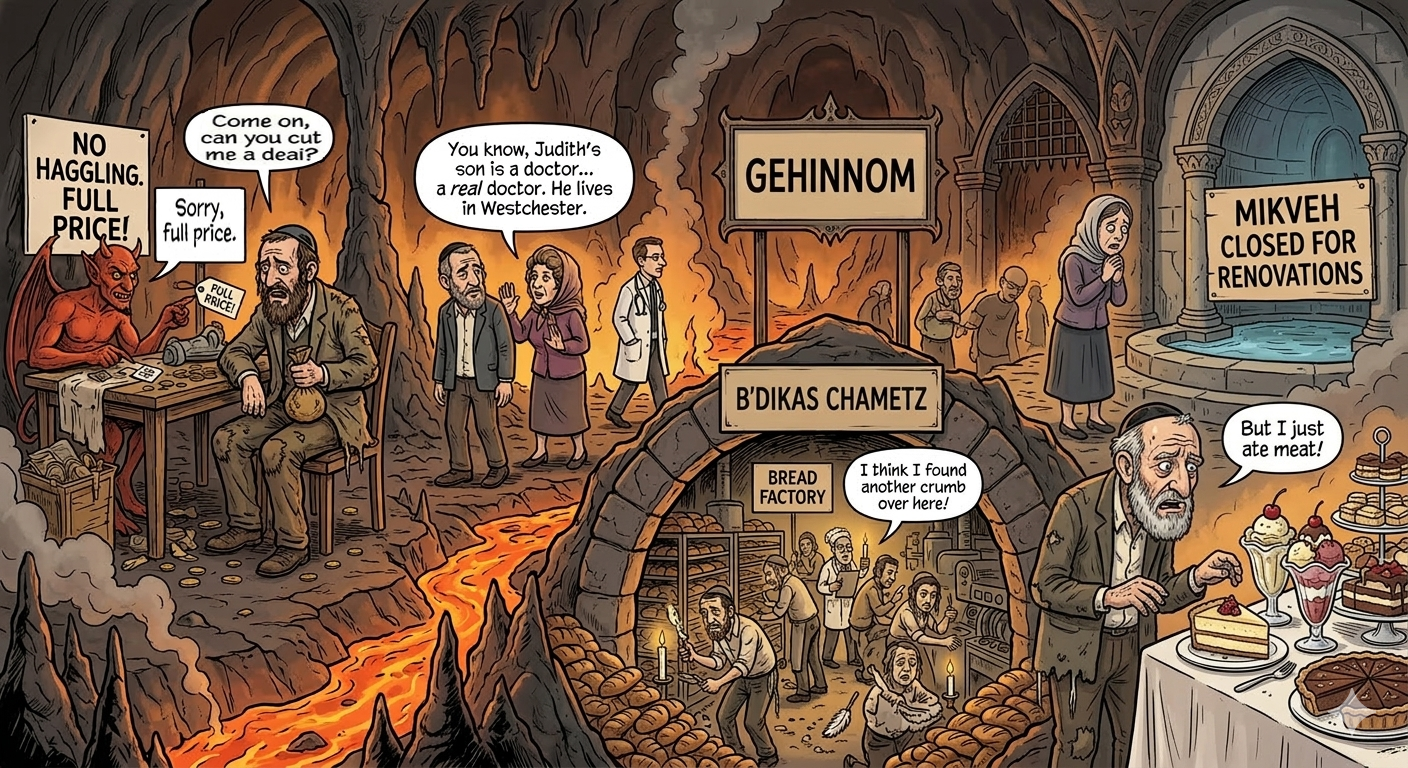
Growing up, I was always told Judaism doesn’t have a hell. I loved that. The concept of a never ending torture fest because you didn’t subscribe to a certain ideology (cough, Christianity) to me felt like the ultimate scare tactic.
Well, it turns out Judaism does have a hell, probably. The Torah itself doesn’t mention much of anything about the afterlife at all. However, through allusions, the Oral Torah, and Kabbalistic thought, there are discussions of what we’d call hell. Most often referred to as Gehinnom, there are lakes of fire, brimstone, and virtually all the things popular culture would have you believe. In fact the Talmud (Berachos 57b) says, “Fire is one sixtieth of [the pain] of Gehinnom.” So yeah pretty bad. But as my rabbi likes to say, “The rest of the world stole it all from us and butchered it.” So even though our popular culture/religious concepts surrounding hell are all rooted in the Jewish tradition, they miss the point. That point being the difference between a morbid manipulative scare tactic versus a powerful insight on growth, chance, and endurance.
Spiritual Reference Point
First off, Gehinnom, much like Olam Habah (aka The World To Come aka Jewish heaven), and everything spiritual are metaphors. Explaining spiritual phenomena is like trying to describe colors to someone blind from birth. Even dreams and meditation are filtered through our perception via symbolism. So a lake of fire is not a lake of fire. Gehinnom can’t freeze over because there isn’t any heat to freeze. There aren’t any particles to reduce kinetic energy. Our concepts of anything physical simply don’t exist there.
The Jews Really are Going to Hell
Yes the Christians are right, Jews do go to hell. That’s because, in the Jewish concept, virtually everyone does! Gehinnom is much closer to purgatory or a place of purification. But where the Christians are right about us going to hell, they are wrong about the duration.
When someone dies, the Jewish custom is to say Kaddish for the departed for 11 months. The Aramaic prayer gives merit to the soul, lessening the severity of the pains of Gehinnom. Why 11 months? Because the maximum amount of time a soul can be in Gehinnom is a full year. We don’t like to think that our loved ones sinned that maximum amount, so the custom is to say the Kaddish for only 11 of those months. Okay… so when a soul is in Gehinnom for (hopefully not) 12 months, what happens?
Three Jews, Five Opinions
As tends to be the case with most things Jewish, there are a number of opinions on the subject. Here are a few to help us understand why the Talmud gives such disturbing metaphorical imagery.
The pain of choices.
The Vilna Gaon refers to Gehinnom as a “din and chesbon” or a judgment and a calculation. Meaning that when one dies there is a judgment for the actions a person did in their life and then there is a calculation of all the things a person could have done but neglected.
This has been referred to as a process akin to sitting down and watching the movie of your life. Then afterwards you watch a movie of your life had you made the best possible choices you were capable of. Upon seeing this second movie, the soul will have so much regret seeing the heights they could have climbed and the opportunities missed, the pain will be excruciating.
The laundry cycle of punishment.
Another understanding of Jew hell (I learned from Rabbi Ben Tzion Shafier) is that it’s actually a tremendous gift. God gives us difficult temptations that are almost impossible to overcome 100% of the time. Sure there’s teshuvah which can wipe the slate clean, but we can’t be doing teshuvah all the time. Is it fair that we’re punished for not always being on our best behavior?
Rabbi Shafier’s interpretation goes like this. When we do a chet (or sin), it leaves a mark on us, something like a spiritual blemish on our soul. When we get to the World To Come if any part of our being is corrupted by said blemish, that part of ourselves will be impaired in the World To Come. Gehinnom acts as a spiritual purification so all such blemishes can be repaired. But only on one condition. If the individual struggled with their chet, trying to improve, even if they failed hundreds of times, they will be able to be cleansed in Gehinnom. But if the person resolved, “Oh that’s just the way I am, why bother trying to change?,” then that part of their soul is forever corrupted and Gehinnom can’t rectify the damage. Sure there is suffering, but there’s an end and we come out the other side squeaky clean for all eternity.
The sin is the hell.
Pirkei Avos 4:2 says, “The reward of a mitzvah is a mitzvah and the wages of a sin is a sin.” The surface understanding is that doing mitzvahs lead to doing more mitzvahs and doing sins lead to doing more sins. But according to Rav Chayyim Volozhin, the Mishnah has a deeper meaning.
According to him, “The true punishment of a sin is the sin itself.” What does that mean? Every action we do creates a consequence, for good or for bad. Sometimes we see the effect immediately, sometimes we see it years down the road, and sometimes we never see it, but it is there. If we don’t see the ramifications in this world, we’ll see them in the next. So it’s not that the suffering we feel in Gehinnom is because we need to feel bad for what we did and thus must be punished, but instead a reality is created and the consequences of that reality must inevitably come back to us. It’s justice plain and simple.
The Shabbat From Hell
So that’s what Jewish hell is. Nice right?
But the reason I decided to write a little about it was because of something in this week’s Torah portion, Vayakhel. The reading once again gives the mitzvah to observe Shabbat and refrain from all melachah (creative work). Then it immediately goes into the building of the portable Temple known as the Mishkan. It’s from the 39 acts of building the Mishkan that we extrapolate the 39 prohibitions which define the melachah that we abstain from on Shabbat.
What’s odd though is that when the Torah gives the prohibitions of Shabbat it says, “You must not kindle a fire in all your dwelling places on the day of Shabbos.” (Shemos 35:3) It doesn’t list any of the 38 other melachah at all. One might think the only Shabbat prohibition is making fire. So to this the Zohar comments, in Gehinnom, even the wicked get a break from the fires of punishment. That’s also why it is such a mitzvah to bring in Shabbat early and to delay ending it. Your rest benefits those below as well as for yourself in the future. Rabbi Dovid Kaplan once told a joke on the matter.
There was once a Jew who worked on Shabbat and was proud of it. When someone came up to him and said “Hey you’re a Jew, aren’t you not supposed to be working on Shabbat?” He responded, “I’m not so religious.” But when he died and was sent to Gehinnom, the angel who was responsible for the fires gave the man a sharp look. When Shabbat came, most people got the day off from their labors. But for this man was herded along with a select few who were sent to keep working. The man asked the angel, “Hey it’s Shabbat, aren’t you supposed to turn off the fires on Shabbat?” The angel looked at him and said, “I’m not that religious.”
Heaven Is Hell
There is no Gehennom in the World-to-Come. Rather, the Holy One, Blessed be He, will remove the sun from its sheath [minartika], and the righteous will be healed by it and the wicked will be punished by it. (Nedarim 8b)
The Talmud in Nedarim puts another spin on the concept of hell entirely. It’s not that heaven and hell are separate places but actually one and the same. You’ve heard the phrase, “one man’s trash is another man’s treasure.” Well this is, one person’s heaven is another person’s hell. For some, an evening at the ballet or a four-hour political debate is something they’d spend hundreds of dollars on. For someone else it would be pure torture.
Just like the quote above that said fire is one sixtieth of the pain of Gehinnom, Shabbos has been said to be one sixtieth of the World To Come. If you treasure undisturbed time with family, cutting off the outside world’s distractions, dedicated time for prayer, and special opportunities for Torah learning, Shabbat is great! But if you can’t stand not looking at your phone, are too concerned with work, or you’ve chosen to live far from anywhere within walking distance, it’s probably something to endure rather than enjoy. So too, for the World To Come. There’s a saying, “The World To Come is a beis medrish (Torah studyhall) with unlimited coffee and no clocks on the wall.”
If you spent your life cultivating an appreciation for Torah, mitzvahs, and holiness, the light of Hashem will be pure splendor. If not, well, the afterlife is going to feel like one hell of a Shabbat.
This was update of a previous blog post from 2019.
 Six Degrees Of Kosher Bacon
Great array of options. Thanks and have a happy Shabbos.
LikeLiked by 1 person