

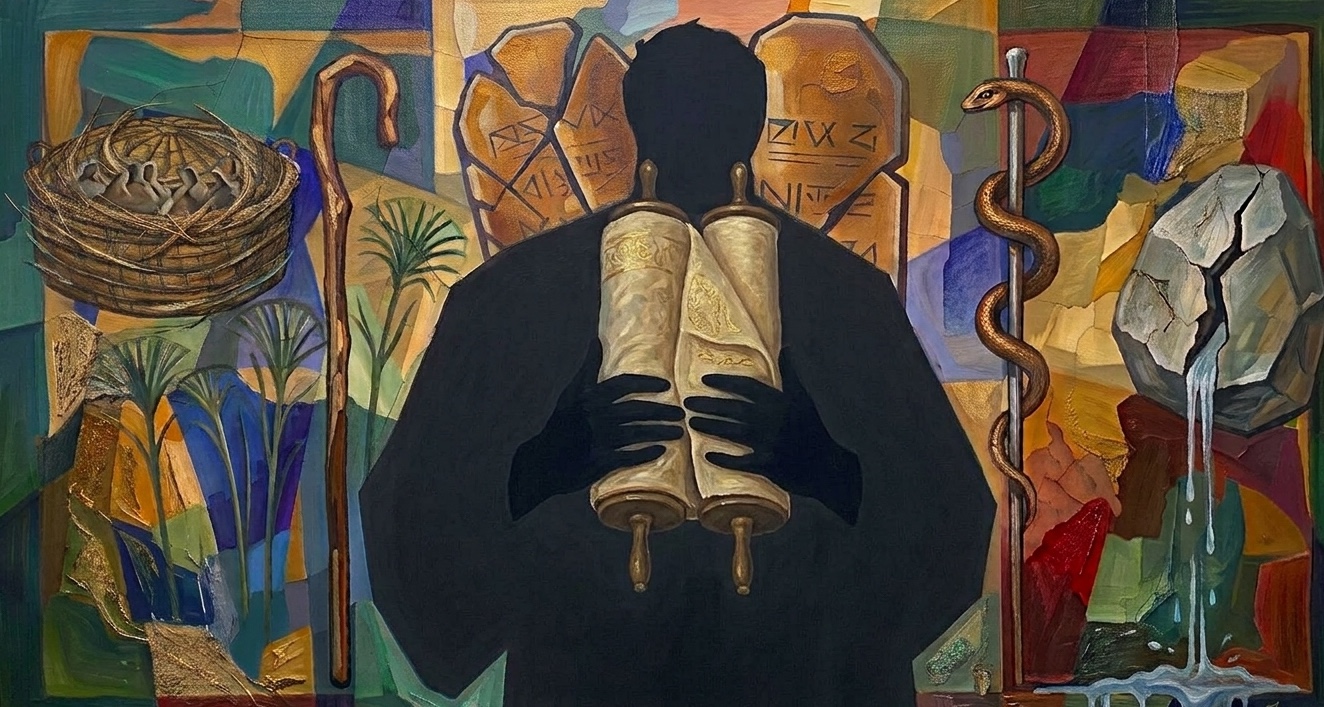
And this is the blessing with which Moses, the man of God, blessed the children of Israel [just] before his death. (Devarim 33:1)
The final parsha of the Torah, Vezos HaBeracha, opens with a verse that calls Moses Ish HaElokim, the man of God. To most of us, “man of God” may simply mean a tzaddik, or holy individual. But the Torah uses the title exactly once. Clearly, there is something more to this epithet.
According to commentators such as the Ibn Ezra, Ish HaElokim highlights Moses’ exalted level of prophecy. Thus the blessings of the tribes that follow aren’t just benedictions, but prophetic statements. Another interpretation holds that the title implied that Moses was on such an extraordinary level he had the power to make decrees and God would carry them out (Midrash Tehillim 90:1). Bereishis Rabba (33:3) highlights the specific name of God that’s used, Elokim, which is associated with strict justice. The Or HaChaim then connects this to a statement in the Talmud: “If the Holy One, blessed be He, were to come and sit in strict judgment over our great patriarchs, Avraham, Yitzchok, and Yaakov, they could not withstand it.” (Arachin 17a) On it the Or HaChaim comments, “This is what the verse means when it says Ish HaElokim. If Hashem were to come to subject Moses to strict judgment he would be able to withstand it since he had so marvelously performed what is good and upright.”
No matter which interpretation you like, Ish HaElokim is an extraordinary title of praise. But for me, the last definition is the most perplexing. Is the Or HaChaim really saying that Moses could withstand strict judgment when the Patriarchs could not? Avraham passed the hardest of tests. Yitzchok was so devoted that he offered his life on the altar. Yaakov, whose righteousness was so great that the Gemara says, ‘Yaakov Avinu did not die.’ (Tannis 5b) And Moses, we know, was barred from entering the land for striking the rock. What was so marvelously good and upright that it not only cleared him, but elevated him above the Patriarchs?
The Or HaChaim doesn’t immediately explain what this extraordinary righteousness consisted of. But later in the same commentary, I think he gives us an important clue. “The man of God blessed the Children of Israel (Bnei Yisrael).” Because Bnei Yisrael is placed immediately after Ish HaElokim it can be inferred that Moses’ greatness came through the Children of Israel. “Though all that he troubled himself for them, and all that he endured from them, and all that stemmed from his good conduct with them, he achieved this stature of being called the Ish HaElokim.”
The Israelites were not the easiest nation to lead. There were the complaints immediately after leaving Egypt (parsha Beshallach), the constant frustration, “I cannot carry this entire people by myself” (Bamidbar 11:11-15), the Meraglim (spies) and the outcry setting the entrance into Israel back 38 years (Bamidbar 14:1-4), Korach’s rebellion (Bamidbar 16:1), after Miriam’s death, the people immediately complain about the lack of water, culminating in the episode of the rock (Bamidbar 20:1-13), and of course the Golden Calf (Shemos 32:1-6). And that’s not even all of the times the Israelites antagonized Moses.
The implication is that Moses’ greatness didn’t come from his devotion to God, or his tireless study of Torah, or even his ascent into heaven on Mount Sinai. It was revealed and perfected through his mentoring, leading, and ultimately shaping the nation that would become the Jewish people. He was given every justifiable reason to walk away, in fact God even gives him an explicit out, “Now leave Me be, that My anger may burn against them and I will destroy them, and I will make of you a great nation.” (Shemos 32:10) But Moses says absolutely not and stands up for them. And he does it again, and again.
In life, we have so much we are trying to accomplish. Work, the dream, family. And it often feels like the people we’re trying to do these things for, not only aren’t appreciative, they even get in the way. A boss who calls a mandatory meeting when it could have been an email. A spouse wanting your opinion about something when you have a deadline. A child who refuses to go to bed when they’re clearly overtired. What I think the Or HaChaim is telling us is that achieving the illustrious goal itself isn’t what makes someone great and doing mitzvahs perfectly isn’t what makes someone holy. It’s the sphere of influence around us and how much we elevate that sphere that is the path of an Ish HaElokim. Our personal struggles to overcome inner flaws, that’s the realm of Hashem, the merciful name of God. But outsiders don’t see our inner struggles. They judge us from the exterior and the laws of society. Moses influenced the nation in that realm. That’s why he’s Ish HaElokim. And it doesn’t matter that he wasn’t perfect, what matters is that he never gave up.
So for us, we all know that things don’t go according to plan. We make mistakes. We may never realize our dreams and goals. That’s heartbreaking. But Moses didn’t get to enter the land of Israel. Yet in spite of our disappointments, are we able to still represent God in a positive light? Are we able to accept those obstacles and still inspire those around us to be good, and loving, and to never give up? Even when they’re the cause of our failure? What a high bar. That’s probably why the Torah only uses Ish HaElokim once, and it is all the way at the end of Moses’ life.

