

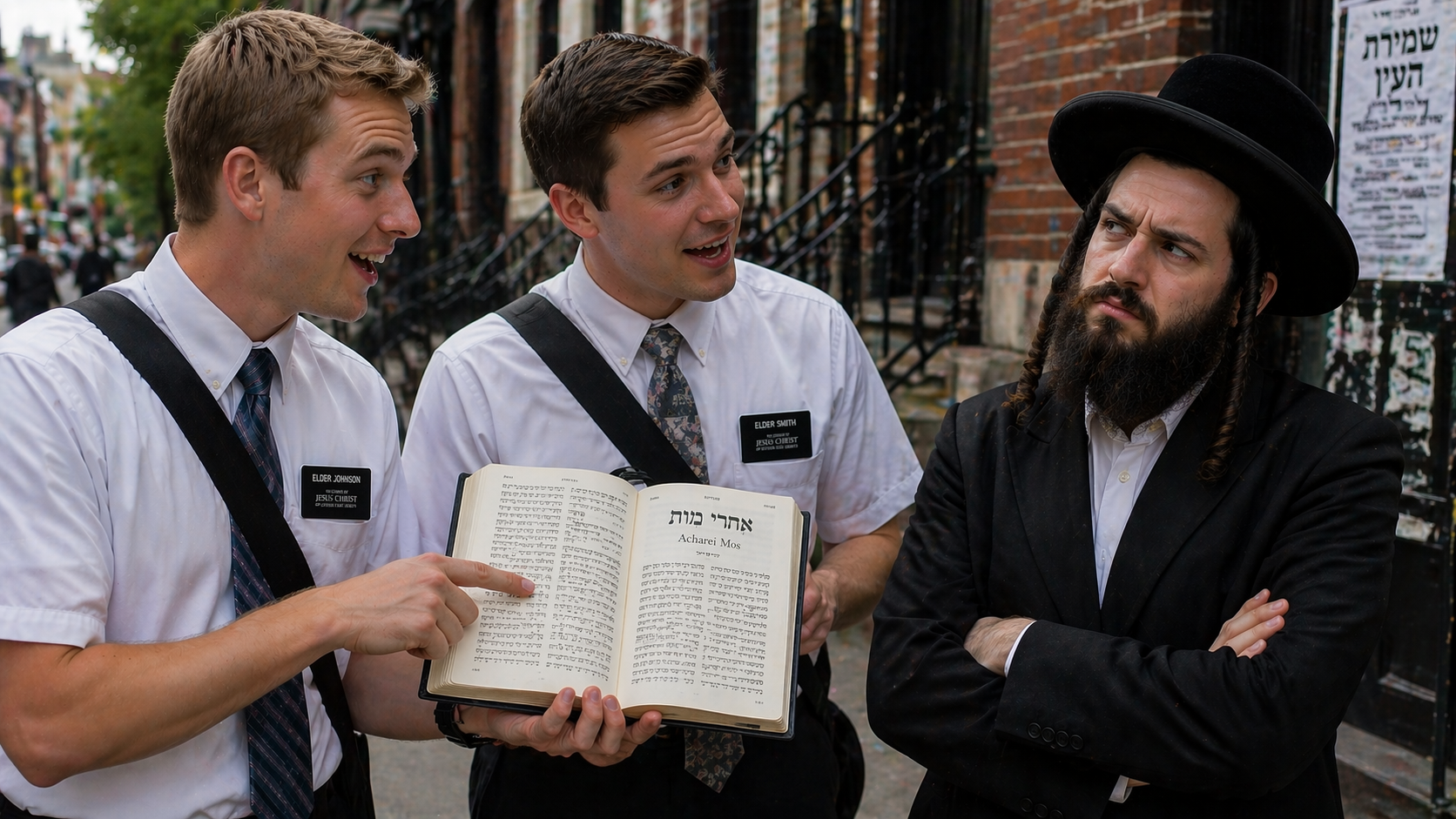
Short answer no. Yes I know the title is pretty clickbaity, but there is a relevant parallel between the message of the Jesus story and something in this week’s parsha Acharei Mos.
I’m not a Christian nor am I educated in Christian theology anymore than the next guy. (However I did write a video about how his story came about historically speaking for OpenDor media.) But my understanding is that the Christian believe Jesus’s sacrifice permanently fulfilled the obligations to bring offerings to the Temple. So where Jews once were required to bring a sin-offering (aka a chattas), now the only way to attain that atonement for sin would be to accept that sacrifice Jesus made. Please correct me if I am wrong about any of this below in the comments.
The idea that the Torah can be changed and mitzvahs can be permanently negated (they say “fulfilled”) is a big contradiction of the Torah itself. We believe that the Torah is eternal and that Hashem doesn’t change his mind. In fact one of the ways we know a prophet is false is if they tell the people to follow other gods and to stop doing the mitzvahs (though a short cessation of mitzvahs is allowable, that how the Jews could fast on Pesach during the Purim story). See Devarim 13:2-6, 18:20-22, as well as Yevamot 90b and Sanhedrin 89b.
However, in this week’s parsha we do have an allusion to the sacrifice of the righteous providing an atonement. The parsha picks up with the narrative after the events of Shemini. Aharon’s oldest son, Nadav and Avihu have just died performing the ritual service of the Mishkan. They did something wrong (what was wrong is a different conversation) and a fire consumed their souls. So the parsha starts acharei mos, “Hashem spoke to Moses after the death of Aharon’s two sons…” From this prelude the scripture almost immediately transitions into the mitzvah of Yom Kippur. What’s the connection?
The Artscroll edition of the Torah comments (page 636) “Why is the death of the righteous [i.e. Nadav and Avihu] mentioned in conjunction with the chapter of the Yom Kippur service? Because just as Yom Kippur brings atonement, so the death of the righteous brings atonement (Yerushalmi Yoma 1:1).”
Pretty coincidental that the death of a righteous figure does in fact bring atonement without an animal sacrifice. But Artscroll goes further…
“However, and this is crucial, both Yom Kippur and the death of the righteous bring atonement only on one condition. Yom Kippur atones only for people who recognize it as a holy day and treat it as such [those who do not] do not find atonement on Yom Kippur. Similarly those who do not honor the righteous in life do not benefit from their ascent to Heaven in death.”
Now we get where the Christians might have gotten the idea that from believing in Jesus’s sacrifice is the only way to find salvation. Does this idea about the righteous’s sacrifice being a Yom Kippur actually support the Jesus narrative? Can we stop doing teshuvah and start eating pork sandwiches? Hardly.
The Meshech Chochmah describes Yom Kippur and the death of the righteous as a eis ratzon or time of favor. Meaning that honoring a (possibly) righteous person who died 2,000 years ago doesn’t yield the magical forgiveness opportunities of a Yom Kippur. Even though a righteous person’s death can provide an atonement for a whole generation, it would only work for that generation.
There is one more crucial difference. The death of the righteous is a profound statement of what life is truly about. As Rabbi Noach Weinberg liked to say, “Until you know what you’re willing to die for, you don’t know what you’re living for.” To be a martyr is to fully dedicate your life to a cause. What would you lie in front of a tank for? To be clear, Judaism honors living for a cause instead of dying for it. So sacrifice doesn’t necessarily mean literal life. There are prosecutors who resigned rather than pursue cases under fraudulent instructions.
It is when we recognize the sacrifices against the evils of today, that we reflect on the missteps we’ve been making and the corruption we’ve been condoning. The atonement isn’t so we can feel like angels. It’s so we can have the courage to act when we’ve felt we weren’t worthy enough to because of our sins. “Who am I to call out evil when I’ve been cheating myself?” Then someone else makes the ultimate sacrifice to call out injustice. If you recognize and honor that, it’s your chance to wake up and use your life to finish what they’ve started.
Atonement is about realigning your life to your true purpose. In Judaism, we believe that means doing mitzvahs to become as close to Hashem as possible. I’ve never understood why the Christians believed that accepting Jesus allowed you to not do those mitzvahs. They say every story is rooted in truth. If the Jesus story is rooted in Acharei Mos, it seems to have missed the point.

