

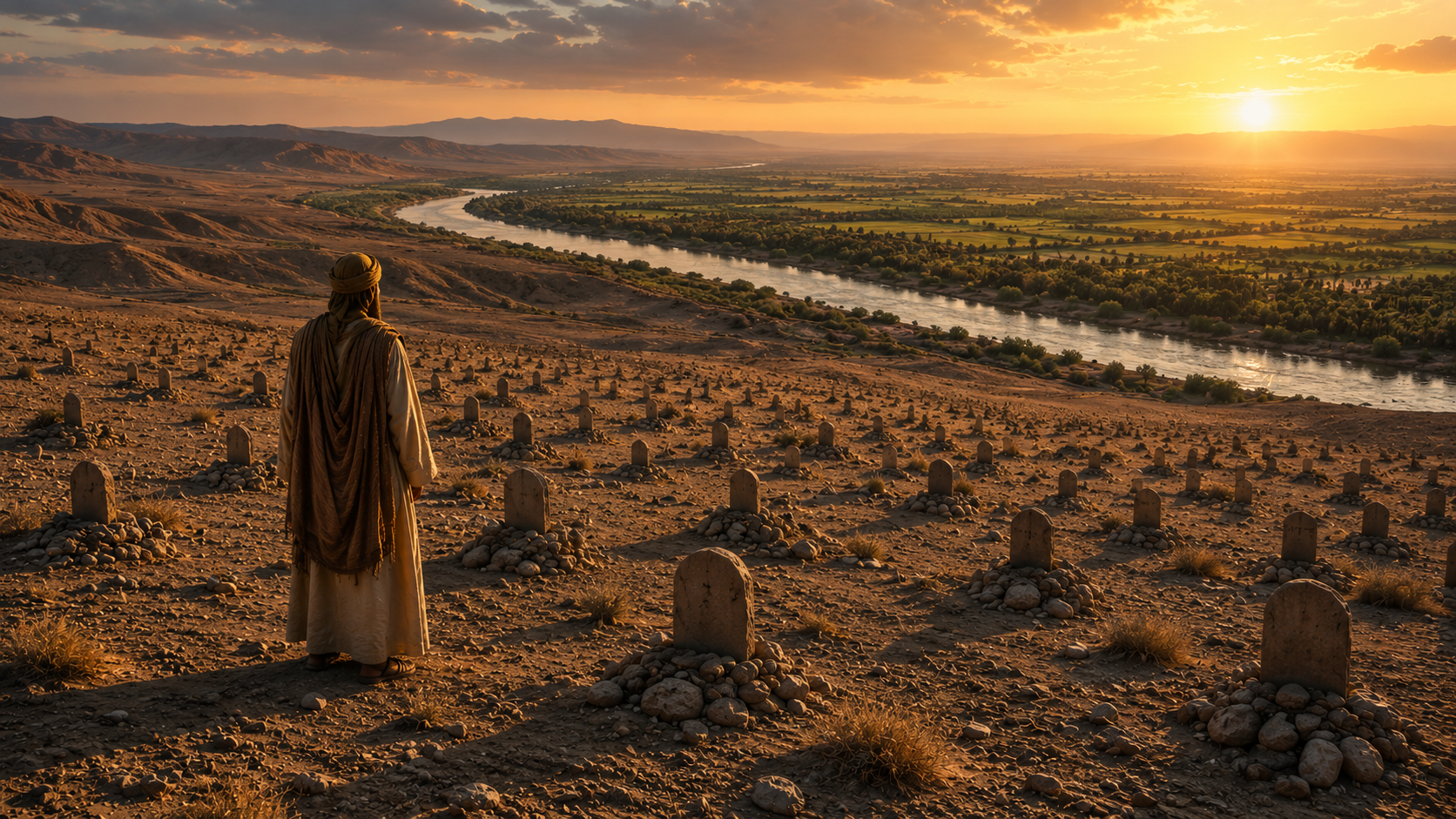
I’m not a fan of the characterization of Hashem as the, “vengeful punishing God of the Old Testament.” To say that means you have to ignore all the wonders, blessings, and compassion on display throughout the Torah. However, if one was to try to prove the wrathful nature of Hashem, parsha Shelach isn’t a bad place to point to. In this Torah portion there are no less than four death penalties enacted by our loving Creator.
- The Meraglim – The men who spied out the land of Israel and gave a bad report.
- The Dor Hamidbar – The Generation of the Desert was sentenced to die in the wilderness.
- The Ma’apilim – Those who defied Hashem again and decided to enter the land anyway.
- The Mekoshesh – The man who publicly gathered sticks on Shabbat.
What did these four groups do and why didn’t they receive the merciful “slow to anger” behavior that the Jewish people ascribe to God?
First off, let’s discuss punishment within a Divine context. Hashem doesn’t sit on a cloud in Heaven waiting for you to mess up so He can hurl a thunderbolt at you. He doesn’t even really get angry when you blatantly transgress the mitzvahs. Hashem has set up a system and depending how you act in that system, your behavior has consequences, cause and effect. If you put your hand on a hot stove, you wouldn’t say the stove was mad at you. That’s just what happens. Doing mitzvahs brings the consequence of blessing and connection. Transgressing mitzvahs brings the consequence of separation and possibly unpleasant effects.
But if it is all cause and effect, how does Hashem’s mercy factor? In chapter 4 of Mesillas Yesharim the Ramchal discusses three ways that Hashem actually buffers the consequences so to speak. 1) Hashem gives us the ability to do teshuvah (repentance) thereby not just fixing the issue, but possibly turning into a mitzvah. 2) He delays the “punishment” so the person can reflect and do teshuvah. 3) When/if the “punishment” comes, the person doesn’t get the full consequence they deserve. Hashem doesn’t throw the book at them.
The Meraglim
Volumes of texts have been written about the 12 spies who explored the land, and the 10 of them who came back with a slanderous report. They were not given time to reflect and repent, but instead died in a horrible and, according to Rashi miraculous, plague. (Bamidbar 14:37). Rashi’s description: “They sinned with the tongue, so their tongues were distended until their navel and maggots came from their tongues and entered their navel…. Blessed is He, Who metes out measure for measure.” Why did the Meraglim not get the chance for teshuvah?
The Or HaChaim lists five things that cause Hashem’s anger to flare so He takes swift vengeance.
- When a great and distinguished person rebels against his Creator.
When a “righteous” person with a large platform transgresses, everyone hears about it and it informs what is acceptable. - When a person keeps company with righteous people but acts crookedly.
A person is influenced by who they spend their time with. If that person rejects that positive influence, he can end up dragging those around him down as well. - When a person experiences a great inspiration not to sin but then does anyway.
We’ve all gotten “the message.” You were about to do something only to be saved in the nick of time from a tragedy. If you ignore that salvation, problems are coming. - If someone sins and causes the public to sin as well.
Leading others astray is one of the worst things you can do. - A great sin that is unnatural to perform.
I’m not going to comment on this one. Use your imagination.
The Or HaChaim proceeds to demonstrate how the Meraglim were guilty in all five ways. When their journey began, they were righteous men of distinction (Bamidbar 13:3). They were associates of Moses which made them guilty of the second factor. The journey in the land was a miracle as they successfully evaded capture and death at the hands of the very strong inhabitants. Obviously, they provoked the entire people to sin with complaints and crying. Finally speaking evil reports about the Holy Promised Land itself was unnatural. “Who could declare a completely beautiful land to be bad?”
Dor HaMidbar
I Hashem have spoken – if I will not do this to the entire evil assembly that gathers against Me; in this wilderness they shall cease to be, and there they shall die.’ (Bamidbar 14:35)
All the men (non-Levites) between the age of 20-60 were barred from entering the Land of Israel. Each year, a number of them would die on the anniversary of the bad report (Tisha B’Av.) This Generation of the Wilderness did get their capital punishment delayed, but they were not able to receive mercy and escape the death sentence. To this, the Or HaChaim says, was actually a kindness. The sin of the Meraglim was so severe that they not only lost their lives in this world, but their eternal life in the World to Come (Olam HaBah).
Or HaChaim comments on the phrase “if I will not do this” to mean that if Hashem completely forgives them, they will continue to sin and they will lose their eternal lives just like the Meraglim. This is what “they shall cease to be” refers to. So even though exile from the Land was harsh, they were still allowed to learn and do mitzvahs, while raising and shaping their children to carry on their legacies. That way, in the end of days, they would eventually be able to enter the Land of Israel in a rectified and perfected state.
The Ma’apilim
“They awoke early in the morning and ascended toward the mountaintop to say “We are ready, we shall ascend to the place of which Hashem has spoken, for we have sinned.” (Bamidbar 14:40)
Most of the Dor HaMidbar accepted their punishment and in the end would feel Hashem’s mercy. However, a subset of these men decided to reject the decree and prove their faith. They launched an offensive (despite Moses’s insistence not to) and were quickly ambushed by the Amalekites and Canaanites. Faith and trust (emunah and bitachon) are a funny thing in Judaism. Had they entered the land before, Hashem would have fought their battles for them and they would have won swift victories. However, as the Chovos HaLevavos states, “If a person places his trust in something other than God, then God removes His Divine Providence from him and leaves him in the hands of the entity in which he placed his trust.” Simply put, if you think your security comes from your 401k and your stock portfolio, then Hashem will leave your fortune to the odds and health of those financial systems.
The Ma’apilim weren’t trying to do teshuvah. Had that been the case they would have accepted Hashem’s decree and Moses’s instruction. Instead, they tried to prove they had trust after all. Unfortunately once trust is broken, you don’t get to will it back. It has to be earned back. So the Ma’apilim were left to face the odds of the warring nations and not the miracle of Hashem’s protection. Let that be a lesson. If you’ve screwed up, don’t try to act like everything is okay and proceed as if your mistake was inconsequential.
The Mekoshesh
“The Children of Israel were in the wilderness and they found a man gathering sticks on the Shabbos day… Hashem said to Moses, ‘The man shall be put to death; the entire assembly shall pelt him with stones outside of the camp.’” (Bamidbar 15:33&35)
The stick gatherer (in Hebrew Mekoshesh) is a really weird instance in this parsha. According to many opinions, it chronologically doesn’t actually belong here, but happened shortly after they left Egypt. Also, for the most part, someone who is just gathering sticks, even though it was a violation of Shabbos, isn’t going to get the death penalty from the Earthly court. In order for that to happen, the transgressor has to commit the sin publicly, with two witnesses who must tell the person, “If you do what you’re about to do, you will be subject to the death penalty.” To which the transgressor must respond, “Yes, I understand what you’re saying, and I’m doing it anyway.”
But since the entire assembly is commanded to stone the Mekoshesh, we know that all of those criteria actually occurred. Because in Torah Law, oftentimes the witnesses to the crime have to carry out the execution. So for the entire assembly to stone him meant his offense was VERY public. Why would the Mekoshesh be so brazen? Well, interestingly enough, according to some opinions, the man was doing it for the sake of the Jewish people and for the sake of Hashem.
Assuming the scenario occurred where it does in the Torah, after the Meraglim episode, the Israelites were pretty down in the dumps. According to the Ramban, the practice of mitzvahs really only matters when we are in the Land of Israel. Outside of Israel the mitzvahs are just practice (this does NOT give you free rein to shrug off the mitzvahs if you’re not in Israel.) But from this perspective, if the Dor HaMidbar are never going into the Land, why even bother?
So the Mekoshesh took it upon himself to violate the Torah to show everyone the mitzvahs still matter. He sacrificed himself to sanctify Shabbos. Surely, such a noble intention deserves Hashem’s mercy.
Well as the saying goes the road to hell is paved with good intentions. For one thing, we have a concept known as mitzvah ha-ba’ah ba-aveira, which means you shouldn’t fulfill a mitzvah by committing a sin. We don’t know which mitzvah is more important, so you shouldn’t violate one to do another. But the other issue is that due to the Mekoshesh’s own intentions, he couldn’t have been let off the hook. If his point was to show the consequences of violating Shabbos, being spared the punishment would have completely undermined his point! He would have shown that breaking Shabbos isn’t such a big deal.
Understanding doesn’t equal mercy.
Everyone who sins usually has a good reason, if not an emotionally compelling one. Or maybe we think we’ve done enough good that our balance sheet can take it. I think that mentality applies to all four groups in Shelach. There’s no question Hashem will understand. But He also understands the consequences of your actions beyond what you could ever imagine. Most of us are given the time and the opportunity to make things right. But in extreme cases, you may not get that. Shelach is full of extreme cases. The Torah depicts Hashem’s reaction to these extreme cases not so we can sit in fear of retribution, but so we can know where “too far” is. Because if we cross that boundary, we may not be able to cross the boundaries that keep us from our dreams and goals. Which is literally what happened to the Meraglim and the Dor HaMidbar.

