

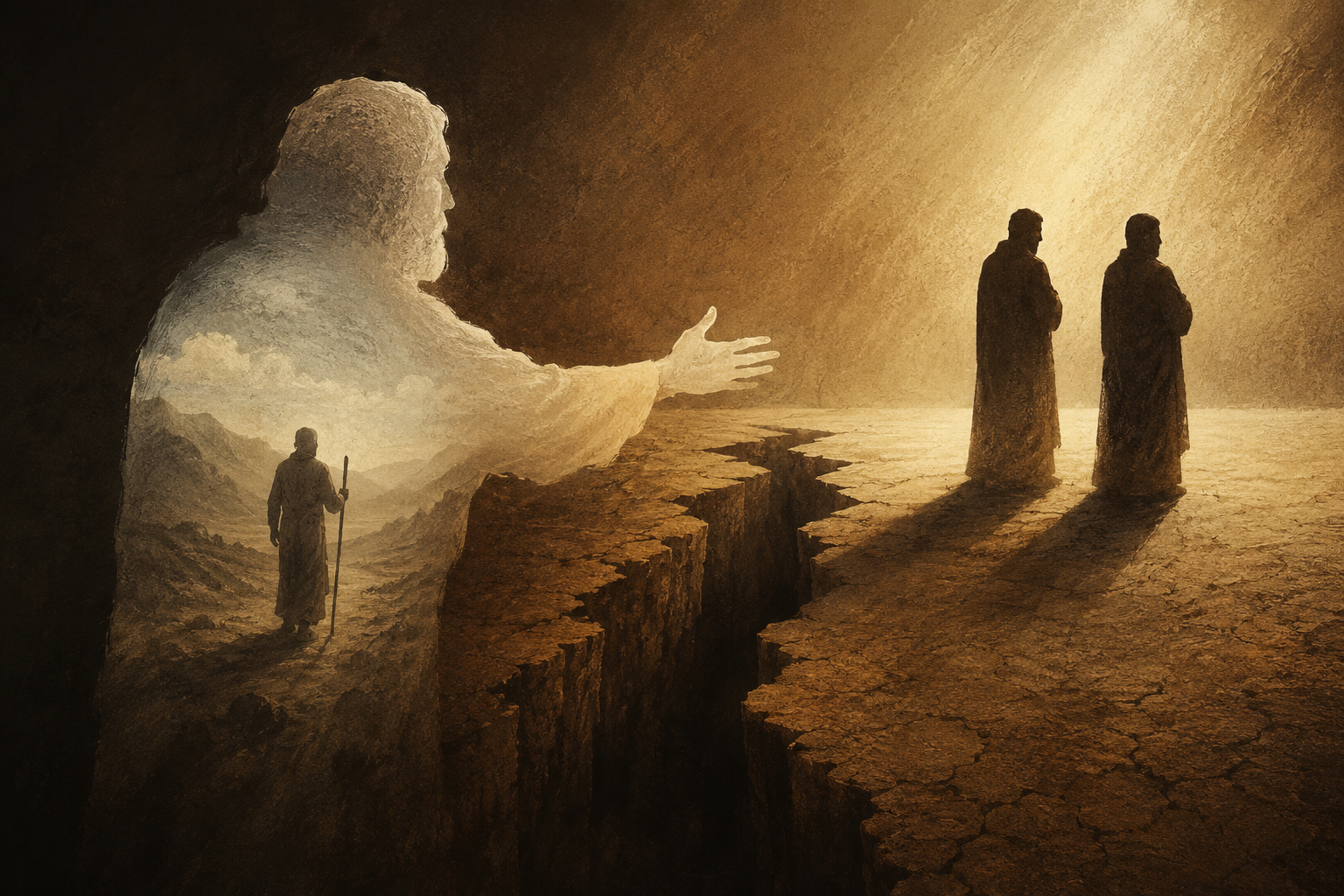
Korach son of Yitzhar son of Kehas son of Levi took himself aside, together with Dasan and Aviram sons of Eli’av, and On son of Peles, descendants of Reuven. (Bamidbar 16:1)
Dasan and Aviram are two of the conspirators in Korach’s rebellion. Many complaints and mistakes are attributed to the two since the Exodus from Egypt. If you grew up going to Jewish day school (which incorporates a lot of the Midrashic stories into their teachings), you might have been led to believe they were a pair of troublemakers. However, this is actually the first time they are named in the Torah. Moses tries to argue with Korach in order to defend his and Aharon’s roles as leaders, but the other 250 rebels are given no such audience. But Moses specifically summons Dasan and Avriam in an attempt to appeal to reason. They flatly turn him down. Why did Moses seek out these two specifically?
Moses summoned Dasan and Aviram, sons of Eli’av, but they said, “We will not go up. Is it not enough that you have brought us out of a land flowing with milk and honey to kill us in the desert, that you should also exercise authority over us?…Even if you gouge out the eyes of those men, we will not go up.” (Bamidbar 16:12-14)
Since the Torah names Dasan and Aviram after Korach, but not the other 250, clearly they had taken leadership in this rebellion. Establishing them as from the tribe of Reuven alluded to the fact that since Reuven was Yaakov’s first born, and so they believed they had a claim to the priesthood, opposed to the sons of Levi. Moses attempted to speak with them alone, away from the chaos of the rebellion, but they knew their claim was baseless so they weren’t going to give up the advantage of an enraged mob behind them.
But if we consider the Midrashic stories, Moses may have been trying to appeal to more than their sense of reason and logic. The most famous story regarding Dasan and Aviram is found in Shemos 2:11. After Moses had killed the Egyptian taskmaster who was attacking a Hebrew slave, Moses went out and saw two Hebrew slaves fighting.
When he went out the next day, he found two Hebrews fighting; so he said to the wicked person, “Why do you strike your fellow?” He retorted, “Who made you chief and ruler over us? Do you mean to kill me as you killed the Egyptian?” Moses was frightened, and thought: Then the matter is known! When Pharaoh learned of the matter, he sought to kill Moses; but Moses fled from Pharaoh. According to Rashi, these two Hebrew men were Dasan and Aviram. The Midrash goes on to say that the reason Pharaoh learned of Moses’ killing of the taskmaster was because Dasan and Aviram informed on him to curry favor with Pharaoh.
They said to Pharaoh, “Moses makes light of your honor. Do you not know that he is not actually your daughter’s son but that he is a Jew?” Pharaoh didn’t care. Then they reported to him that Moses had murdered an Egyptian to which Pharaoh replied, “That is going too far, he must be put to death!” (Yalkut Shimoni)
If the Midrash is to be believed, it makes Moses’ summoning of Dasan and Aviram all the more perplexing. Why would he try to reason with the two people who already had him removed from his position of authority once before? According to the text from the confrontation that Moses tried to stop, Moses called them “wicked” for coming to blows. Clearly the two men were still wicked, so what hope does Moses think he has?
According to the Midrash in Shemos Rabbah, the Hebrew being beaten by the Egyptian taskmaster was none other than Dasan himself. Moses killing the taskmaster saved Dasan’s life! This moment is literally the first time Moses makes an active decision in the Torah. Before this he’s just a baby. By choosing to intercede, he chose his Jewish nature over his Egyptian nurture, and took a stand which would set him on a path for eternal greatness. But the immediate reaction from the man he saved isn’t gratitude. It is betrayal, exposure, and his own life threatened. Dasan isn’t just another Hebrew Moses tried to teach and lift up. He’s a key part of the most important decision Moses ever made. Every mitzvah Dasan ignores, every mockery Dasan levies, every Jew who becomes disconnected because of the doubt Dasan spreads, and every one of the 250 men who will die because of the rebellion, that’s on Moses to some degree.
Seen in this light, Moses’ summoning takes on a whole new meaning. He may not have been just trying to reason with Dasan. He was trying to save him once again. Moses is the leader of Israel because of Dasan, despite the fact that Dasan’s been attempting to undermine him ever since. And on the flip side, I think Dasan’s refusal to meet with Moses is because he can’t face the man who saved him. “Even if you gouge out the eyes of those men, we will not go up.” Gouge out their eyes? What a weird phrase. Some say it may mean a literal threat, but others understand it as an accusation of deception, or pulling the wool over our eyes. Dasan is saying, “I still know what you are, an Egyptian prince,” but at the same time he’s blinding himself to who Moses has become and that he really wants what’s best for him.
In that light Moses’ attempts to save Dasan are tragic. But I think there are a couple of lessons to be learned here. As I mentioned above concerning the Rashi on the Dasan and Aviram fight, Moses refers to the pair as wicked for fighting. One must be careful when giving rebuke. Later in parsha Eikev, when Moses is addressing all of the Children of Israel he will speak about the rebellion of Korach. But there he only mentioned Dasan and Aviram as being the culprits, not Korach. Rabbi Yaakov Pinto notes that the children of Korach survived the punishments from the rebellion, they were present during Moses’ speech, and Moses didn’t want to embarrass them. When one gives mussar (behavioral advice) you must make sure not to embarrass the person. They may completely reject what you’re trying to say and instead harbor deep resentment, as Dasan apparently did.
The other thing to take from Moses is that we shouldn’t do the right thing and expect it to ever change anyone else. There’s a trope in cinema where the hero saves the villain, and that inspires a change of heart. The Torah might be saying that that’s not likely to happen. Do the right thing because it is the right thing and because it changes you. But to hope or anticipate the favor will ever be reciprocated will only lead to more resentment.
Dasan and Aviram suffered a fate worse than the other conspirators. That must have weighed heavily on Moses if the Midrash is to be taken literally. The burden of leadership means that you can’t make everyone happy and there will be detractors you can never win over. Some leaders would write those constituents off or even turn vindictive towards them. Moses, however, despite the futility, refused to give up on them. That’s why he was the right leader for the Jewish people.


Really great take on this!! Thanks and have an amazing Shabbos.
LikeLiked by 1 person