
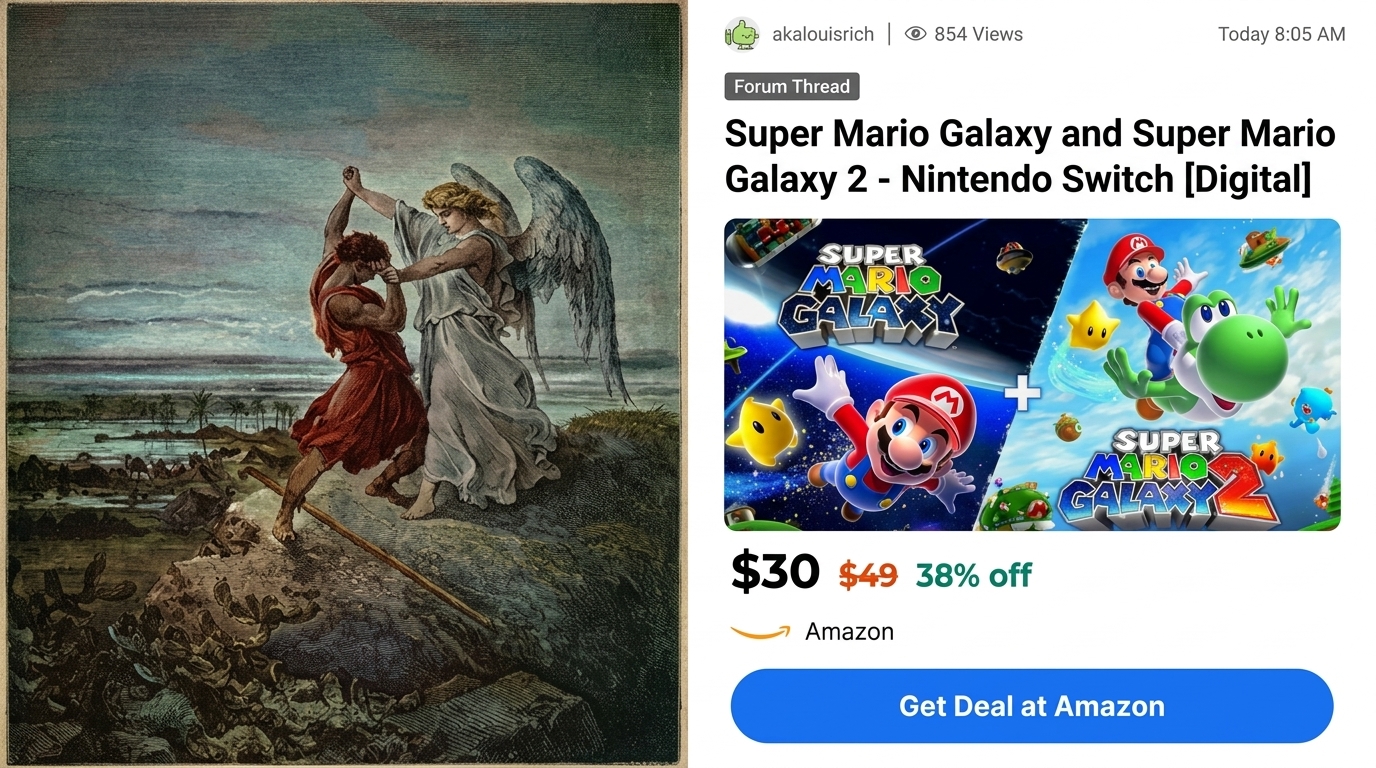
And Yaakov was left alone, and a man wrestled with him until the break of dawn… And he (the angel) said, “Let me go, for dawn is breaking,” but he (Yaakov) said, “I will not let you go unless you have blessed me.” (Bereishis 32:25-27)
I’m staring at my cart in Amazon looking at a Black Friday deal for Super Mario Galaxy 1&2 for Nintendo Switch. $30.00. Normally the games retail for $69.99. During Prime Day, just over a month ago it was $45, but I made a decision then. No.
I’m not against video games. But I already have this game, (the original version from 20 years ago). In fact, after deciding not to buy this remastered version, I pulled out my Wii and started playing it. It’s great. But $30? For better graphics and convenience? I started debating with myself. I notice the sale is expired if I look for it in another window. But because it is still in my cart, the $30 price is still available. What’s $30? $15 for each game, surely a great deal even if I already have the inferior versions. It’s really not much at all.
Then I remember that before Yaakov wrestled with the angel he went back for “pakim ketanim.” As Rashi says: “He had forgotten small bottles and returned for them.” He wrestled all night against the angel of Esav for less than $30. Then it strikes me: that scene is in this week’s parsha.
Then an answer to another question about the parsha dawns on me (no pun intended). Yaakov wrestles with the angel all night until the break of dawn. That’s when suddenly the assailant pleads with Yaakov to let him go. Commentators explain this saying that the angel wanted to sing shira, supreme praises to G-d, having completed the mission of its creation. But what if the break of dawn wasn’t about the angel? What if it was also about Yaakov?
Clearly, this Super Mario struggle is about more than a video game. It’s about a behavior of spending, impulse control, how I spend my time, and being satisfied with what I have. I’ve made a decision, and now it’s being tested. In a way, it’s really testing who am I, what are my priorities and what am I going to do with my time? Those questions are clarified through tests from the yetzer hara (the seducing inclination).
When one passes a test they are elevated to a new level. Clearly we see that with Yaakov getting promoted with the name Yisrael from his victory. But why until dawn? This is my own idea, but I think the implication is the following: When we resolve to do or abstain from something, that decision is continually tested. The more emotionally enticing, the temptation keeps coming back to us. If you look at the Garden of Eden story, the snake tempts Eve multiple times with more enticing arguments. So too with us, we are continually tested, possibly until the middle of the night when we’re at our weakest. But then there’s the break of dawn.
Judaism believes every morning we’re a new person. The slate is clean, so to speak. Every morning there is a prayer called Elokai Neshama that reminds us “My God, the soul You placed within me is pure.” In Eicha 3:22–23, Jeremiah writes that God’s acts of kindness never cease and are “chadashim labekarim”—”new every morning”. Classical Midrashic commentaries expand on this verse, teaching that God recreates human beings anew each morning so they can begin fresh with renewed strength. And in the first blessing before Shema, Yotzer Or, it says Hashem “renews in His goodness, every day continuously, the work of Creation.” The point being, that holding out until the morning, elevates us to a new level. We likely will still have the temptation, but that’s why they say, “one day at a time.”
So when the angel is trying to escape at the break of dawn, why does Yaakov demand a blessing? The Piacenza Rebbe gives this answer. “Yaakov said, ‘Is that it? Is this to be the fate of my children? After they have suffered all the pain and sustained all the damage inflicted on them, is this to be their whole victory? That they survived, that their enemies failed to finish them off? And will they then simply revert to the same state they were in before all their suffering? It must not be!’ This is why Yaakov said, ‘I will not let you leave unless you bless me.’ He was trying to ensure that after the suffering, not only would their enemies leave them alone, but that there would also be salvation from God.”
We’re all struggling with something. Whether that is anger, being productive, addiction, or whatever, we’re bombarded with little tests throughout our day. We’ll pass some, but fail others. But what I think can be taken from Piacenza Rebbe’s quote is that passing a test, even a little one, gives us some elevation. We speak a lot about how Yaakov wrestled with the angel all night and was renamed Yisrael and how holy that new name is. But remember, the name Yaakov refers to how when he was born, he was holding on to the heel of his older brother. From the moment of his birth he was holding on to hope. Then this fight with the angel ends with Yaakov holding on again, refusing to let go. Yisrael would have become Yisrael if he hadn’t been Yaakov first. Just as Super Mario Galaxy challenges us to overcome one obstacle after another in pursuit of that next Power Star, our lives are a series of trials, tests, and battles. We may not win every battle, but as long as we’re holding on to hope of eventual victory, every little battle brings us closer and closer to who we know we can be.

